
Kustini, Priceless Time, 2025. Sing Lit Station.
II. The eerie city: The rise of migrant poetry (2004-2017)
Written by Ada Cheong
Dated 18 Dec 2025
2004 – Amrakajona, a poetry interest group, was founded by Zakir Hossain Khokan
2006 – Banglar Kantha, a Bengali newspaper, was started by AKM Mohsin
2011 – A community centre called Dibashram was opened by Mohsin
2013 – The Little India Riot was sparked by the death of Sakthivel Kumaravelu
2014 – Inaugural Migrant Worker Poetry Competition (MWPC)
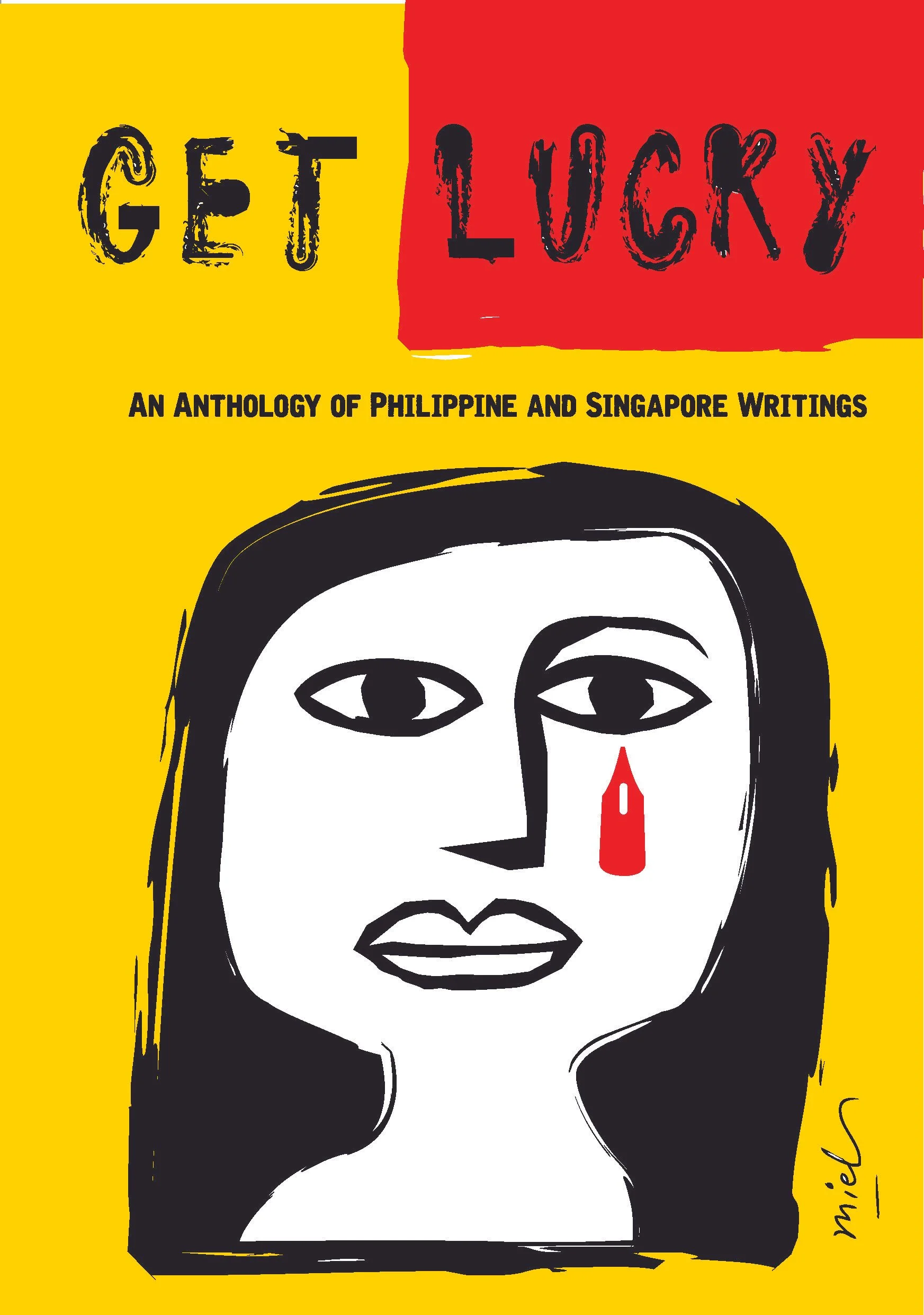
2015 – Get Lucky, a Philippine-Singapore anthology of essays, stories, and poems
2016 – Md Sharif Uddin's “Little India Riot: Velu and a History” commissioned
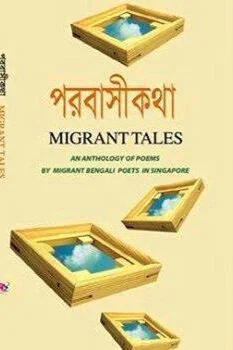
2016 – Migrant Tales, anthology of poems by Migrant Bangladeshi poets
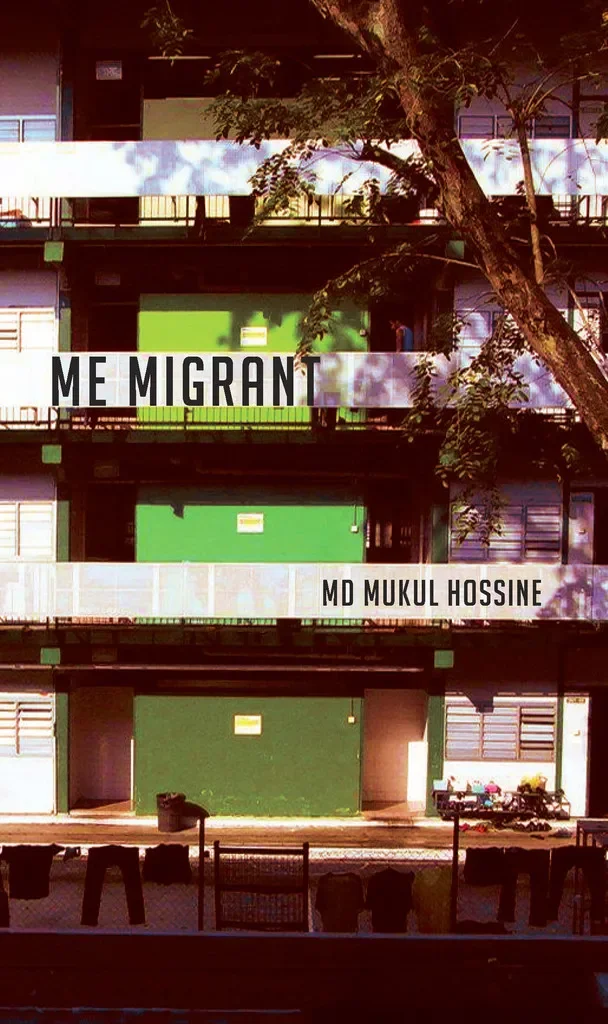
2016 – Me Migrant, Md Mukul Hossine’s first poetry collection
2017 – Songs from a Distance, a collection of 2015 and 2016 MWPC poems
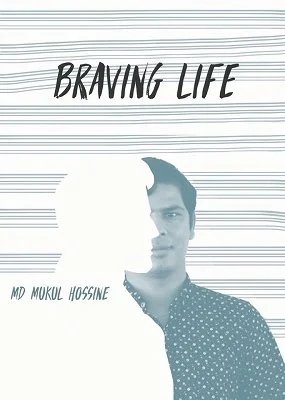
2017 – Braving Life, Md Mukul Hossine’s second poetry collection
2017 – Migrant Library set up by Ripon Chowdury, AK Zilani, and Fazley Elahi Rubel

Migrant poetry in Singapore can be said to originate with the voices of Bangladeshi workers. Hailing from a nation even younger than Singapore, they draw on a history in which poetry was central to struggles for linguistic and political self-determination. Poet activists were key to protests against the imposition of Urdu as the sole national language of Pakistan in 1952 (Chowdhury 2023; BBC 2021) and during the 1971 Liberation War (Radice 2006; Haq 2023), later becoming canonical in the literature of the new nation. Dreaming of a better future and fighting for it is a core part of the nation’s culture, with youth protests driving out corrupt ex-prime minister Sheikh Hasina as recently as 2025.
The roots of migrant poetry in Singapore are found in literary communities organised by Bangladeshis in Singapore, who longed for poetry here. In 2003, Zakir Hossain Khokan left his freelance journalist job in Dhaka to work as a construction supervisor in Singapore. Surprised at the lack of poetry in mainstream Singapore newspapers (Khokan 47), Zakir founded a literary interest group in 2004 called Amrakajona (We Are) for Bangladeshi literary enthusiasts to come together. The group held poetry recitals, plays, music events, and annual book fairs for the Bangladeshi migrant community. Two years later in 2006, another literary platform emerged when A.K.M. Mohsin, who had come to Singapore in 1991 to study English and computing and later became a permanent resident, founded the newspaper Banglar Kantha. Aiming to preserve Bengali language and culture among migrant workers in Singapore, the paper offered poetry, short stories and commentary in Bengali (Peh 2016). Mohsin later opened a community centre on Rowell Road in 2011, called Dibashram, where workers gathered on Sundays to write, perform, and make music (Peh 2016). With the lack of affordable public spaces catered to the migrant community, these early Bangladeshi literary communities provided a space for self-expression and leisure for migrant workers on their days off.
It is only after the 2013 Little India Riot that migrant poetry in Singapore rose to prominence in the public eye. The official narrative around the Riot, produced by the state’s Committee of Inquiry, divorced the riot from any suggestion of systemic issues in the way Singapore treats migrant workers. This is yet another example of what Fisher might consider Singapore’s dreamwork. Relevant faultlines, including the increasing number of workers housed in rural dormitories starting from 2007-8 (Goh 2014, Tan in TWC2 "MOM"), and the lack of public transport infrastructure for this community (Goh 2014), were largely ignored. Instead, the Committee findings, and mainstream reporting around it, crystallised an image of South Asian migrant workers as drunken criminals that require close supervision and control (Kaur et al. 27, Greener 46). This justified the subsequent implementation of Liquor Control Zones and other alcohol restrictions targeted at migrant workers.
In the face of such dehumanising rhetoric, the literary arts rose to complicate and challenge the official narrative around migrant workers. Md Sharif Uddin, a Bangladeshi safety supervisor and writer, was later commissioned to write about the Riot in Gwee Li Sui’s Written Country (2016), a collection featuring defining moments of Singapore’s modern history through literary works. Titled “Little India Riot: Velu and a History”, the poem humanises the migrant worker as a person with feelings and dreams.
Sharif’s poem encapsulates key features of the migrant poet aesthetic that recurs across the other works studied here. The poem presents two forms of dreaming: Singapore dreaming and migrants dreaming. On the one hand, the Riot is cast as a nightmare from which:
The civilised woke up later to say this and that,
but everything stops at night.
The shocking violence of the riot, the first in four decades, felt surreal and dreamlike within an otherwise tightly surveilled and peaceful city. Yet the facade of normality “stops at night”, suggesting that while Singapore’s dreamwork continues in the light of day, the “repressed anger” of the migrant precariat threatens to resurface and destabilise this business-as-usual.
Singapore, the poem reminds us, is a “city of dreams” in more ways than one. Migrants dream in Singapore too, with fragile and precarious dreams which “cry” and can be “killed in an instant.” Yet they dream on, haunting the city as spectral figures. Despite being buried in the earth in a coffin, the speaker tells us that Velu lives on “in a worker’s heart” and continues to “spea[k] silently for a thousand years.” There is a strange haunting that emerges in the poem as workers like Velu become spectral figures, destabilising Singapore’s capitalist realism. If, as Fisher writes, the eerie destabilises capitalist realism by highlighting the absence or lack of something where it should exist (Weird 12), disturbing what is ordinarily taken for reality (Weird 13), then Sharif’s poem turns Singapore into an eerie city. The migrant workers who dream and die within it are invisibilised, returning instead as echoes of the repressed.
The Migrant Worker Poetry Competition
The Riot was also a key catalyst for the founding of the Migrant Worker Poetry Competition (MWPC) more immediately in 2014, which catapulted migrant poetry into the public eye. As Ibrahim writes, “Das and the other organisers of the poetry contest conceptualised it as a public relations exercise that could challenge negative stereotypes about migrant workers.”
Pioneered by TWC2 volunteer Shjivaji Das and Mohsin, it was a natural extension of contests at Dibashram, with the first iteration of MWPC featuring male South Asian poets. Zakir, Rajib Shil Jibon, and N Rengarajan became the first ever MWPC winners. In 2015, these poets garnered significant favourable press, both local and international, and top winner Zakir was invited to give a talk about his poetry at TedxSingapore that year.
It was also the start of partnerships between migrant poets and local literary-artistic communities. Writers and translators such as Alvin Pang and Gopika Jadeja were key to making the poems accessible and visible to local audiences. The second iteration of MWPC in 2015 drew the support of local bodies like the National Library and The Literary Centre, and SMU Wee Kim Wee Centre. In addition, inspired by poetry of Zakir and Jibon, dance company CHOWK performed From Another Land at the Esplanade Theatre Studio in the same year. Later editions of MWPC would include a broader range of writers; since Aidha’s involvement from 2016 onwards, more domestic workers from Indonesia and the Philippines have joined the ranks of shortlisted and winning poets.
Unlike in the early years of Amrakajona and Banglar Kantha, migrant poetry from 2014 onwards was translated into English, and very clearly intended to reach beyond migrant enclaves in Singapore. The politics of migrant writers and organisers quickly became extremely relevant to their poetics, and the modes in which migrant poetry is produced, translated, and published, became more widely debated than their aesthetics. While the material contexts surrounding the publication of migrant poetry remain relevant, I am more interested here instead in the literary and aesthetic significance of these works.
The shortlisted MWPC entries from 2015 and 2016 were published in a collection called Songs From a Distance (2017), edited by Shivaji Das, Vanessa Lim, and Randy Yeo. The poems were originally composed in Bahasa Indonesia, Bengali, English, Mandarin, Punjabi, Tagalog, and Tamil, and translated by an extensive team of volunteers into English. Collectively, these poets articulate the irrealist experiences of alienation and precarity faced by migrant workers. In these poems, the migrant worker emerges as an isolated and spectral figure that occupies a liminal position in the city of dreams.
Many of these poems are set in long, sleepless nights; this is perhaps unsurprising, as it is when migrant poets have time to craft their verses, after the rush of the workday. In different languages like Mandarin, Tamil, and English, they articulate the solitude of the night. Hou Wei (Mand.) describes a “solitary pillow and a torn quilt” as “the smell of the evening downpour seeps through [his] bare window”, while Palanivelu (Tam.) “like[s] the darkness of night”; Grimaldo Nora Rioflorido (Eng.) “wrote a poem tonight”; Guan Zhiqiang (Mand.) writes “When the shadow of [his] back grows long in the moonlight”; and Luo Lai Quan (Mand.) feels the “yearning for home once again” on a “chilly night”. In these poems, the night becomes a threshold where their speakers remain awake while the rest of the city sleeps. Wakefulness takes on a dreamlike quality, as they drift between memories of their hometowns and visions of a better future that always seems just out of reach.
The speakers in these poems are isolated in this liminal space, and emerge as lone voices, often met with the oppressive silence of night. The titular poem of the collection, “Song from Distance” (2016) by Susilowati (Bahasa Ind.), describes the work of “reknitting the fragments of a dream” as a lonely endeavour. In the translation of the poem by Azahar Ahmad Nizar, the speaker’s “words / Whispered by Twilight” are drowned in a “raging calm”; and while she “serenade[s]”, “sweat[s] and sigh[s]”, the sibilant verbs ultimately stifled with the last word in the poem: “Silence!”
Likewise, in “A worker’s journey” (2014) by Md Sharif (Beng.), the speaker is restless at night. The poem, translated by by Gopika Jadeja with Debabrata Basu, Shivaji Das and Souradip Bhattacharya, begins with “The longing of a sleepless brain”, but the things that it longs for never seems to come to fruition:
The longing of a sleepless brain
For a golden morning
For a break in the rhythm
For the beginning of the race
The directionality of such longing is undercut by the repetition of “For” in the subsequent three lines. While modifying that initial noun phrase, they loop syntactically back to it, creating patterns of circling back rather than a forward momentum. This pattern is repeated in the refrain of the poem “I have to run, keep running”. The line jitters back to the initial verb “run”, but extends it through the present participle form, grammatically enacting the unceasing motion and restlessness of the long night.
This circling back is also seen in the form of “Night Elegy” (2015) by Zhang Haitao (Mand.). In Tan Dan Feng’s English translation of the poem, the cascading form of the original is retained, and the last word of each line is repeated at the start of the next, longer line:
Mourn
mournful lament
lamenting worldly things
things that trouble the soul
soul and body already broken
broken dreams bring restless sleep
While the speakers of Susilowati’s and Sharif’s poems yearn for a better future, Haitao’s speaker longs for home. The repetition of words across the line breaks creates a sense of disjointment, mirroring the way in which snatches of the past surface somewhat unexpectedly, and memories unravel in a spiraling rather than linear fashion. The mourning lament of the speaker is also met with silence: “A lamp flutters alone / a lone man awake, while beyond the balcony there is no sound”.
Writing during these interim hours, these poets are stuck in limbo between the homes they left behind and an out-of-reach future. The lack of forward movement and slowing of time is characteristic of the lived experiences of the migrant precariat. As geographer Paul Knox writes, the economic polarisation of global metropolitanism also changes experiences of time and space; “a ‘fast world’ (the triadic core and its archipelago of world cities)... is becoming decoupled from the ‘slow world’ (the periphery)” (14). In a city where most enjoy the time-space compression of a globalised metropole, brought about by efficient transportation systems and the instantaneity of the high-speed internet, the migrant worker remains trapped in a slow world. Their lives are often suspended in delay, waiting for company lorries or spent on long commutes to remote dormitories, waiting to be paid, or facing lengthy bureaucratic processes just to transfer to a new job or return home. In the nocturnal moments of these poems, time dilates, mirroring the broader liminality of their existence. They are caught between a better future that never quite arrives, and a longing for the homes they can no longer fully return to.
Neither here nor there, the migrant worker becomes a spectral figure. In many of these poems, the speakers gaze at or speak to loved ones, but these loved ones do not seem to hear or see them in return. Zakir’s “Pocket” poems are emblematic of holding a loved one in the mind’s eye but feeling thoroughly estranged from them. For female poets, the isolation they experience is often extremely material; as Rolinda O. Española (Tag.) writes in “My Story”, she came to Singapore with her eyes “bright” and “full of dreams”; but was quickly given “No phones… No talking to anybody, even to fellow Filipinos”. As domestic workers live in their households of employment, employers have an inordinate amount of control over where they go, when they sleep, who they talk to, and what they eat. The physical and emotional distance they experience, often from their children back home, becomes even more poignant. Poems such as “Perfect Lullaby” (2016) by Nur Hidayati (Eng.), “A Mother’s Loneliness and Her Wish for Her Child” (2016) by Glory Ann R. Balista (Tag.), and “My Wish” (2016) by Rolinda (Eng.), take on a confessional tone, speaking to children whom they know might never pay heed to their words.
Beyond being isolated from their loved ones, migrant poets are also largely disconnected from the cityscape. In a system that creates precarity and indignity for migrant workers, they are thoroughly alienated labourers in the Marxian sense: estranged from the products of their work, and often stripped of agency in their labour. It is no surprise that the speaker of “Missing You” (2015) by Wiwik Triwinarsih (Bahasa Ind.) finds that her “feet are not in step with [her] heart, / [Her] heart moaning and groaning, [her] feet refusing to budge.” This disjunction captures a sense of one’s desires being out-of-step with the world around.
This sense of alienation is also a result of a system that ensures their transience, vulnerability, and thus exclusion. Like the haunted city of Sharif’s “Little India” poem, the garden city is made eerie in Monir Ahmod’s “The Labourer” (2015), translated from Bengali by Gopika Jadeka and Debobrata Basu. While resembling “weaver birds’ nests” and a “dense loveless forest”, the beauty of this city is soulless. Traces of migrant workers and “the touch of [their] sweat has been erased”, casting them into an “unread history”. Monir’s poem articulates the artifice and strangeness of a Singapore Story that proclaims the rise of a glamorous global city while eliding traces of the manual labour on which it is built.
Similarly, Mohor Khan’s “Lamp Post” (2015) expresses the strangeness and irrealism of working in Singapore. In the poem, translated from Bengali, the city is made strange and wondrous, assuming a mythic and otherworldly quality as “the chariot of the world”. Mohor’s poem edges toward the magic realist, transforming the city into an idyllic dreamscape where “its traffic [is] melodious”, with “Trees nurtured as carefully as children” and birds singing “with the magical voice of forever spring”. Despite being a self-proclaimed “mad city lover”, the speaker is largely detached from the euphonious audioscape of the city, surrounded instead by the “miserable cry of [his] son” and the noises of an “underground train of dreams”. He is a “nocturnal creature”, stuck in limbo and unable to share in the city’s melodious progress.
Yet, the MWPC migrant poets do not only unsettle Singapore’s capitalist realism by articulating the liminality and isolation experienced by the migrant precariat. Most significantly, they refuse to give in to nihilism, insisting on the sensuousness of life to reclaim presence and vitality in a system that seeks to reduce them to units of precarious labour. Drawing on vivid sensory descriptions, their words often estrange and aestheticise the world around them, transforming the everyday into something uncanny and charged with meaning. This sensuousness is not just an echo of South Asian or Sufi traditions, but spans across languages and nationalities.
Throughout the collection, breathtaking images jump out from the verses of migrant poets. In “Untitled” (2015) by Palanivelu (Tam.), he offers “the dreams that [love] gives us” through close-up, intimate details: faces that smile, the twirl of a moustache, the scent of babies, the eyes of a beautiful woman, moist breezes and the sounds of cicadas—and a mother’s nose-ring that shines as brightly as the stars. Migrant poets write startlingly beautiful details of their hometowns: pear blossoms in a light spring drizzle (“Night Elegy” by Zhang Haitao, Mand.); a dog called Blackie barking at the gates while an old parent stands behind him and leans on a cane (“Mother” by Luo Lai Guan, Mand.); and the smoky brass sky and an evening that stands still at the door of the stars (“I am Sorry” by Zakir Hossain Khokan, Beng.). Perhaps the most striking is Bikas Nath’s “Why Migrant?” (2016, Beng.). Unlike the long, silent nights of migrant life, the poem is filled with sounds of home: laughter over a steaming cup of home-made tea, tinkling anklets, a guitar being strummed, folk melodies, and kabaddi being played with friends. Beyond the auditory, the poem also evokes the visual and olfactory: dew-drenched grass, the heady aroma of jackfruits, and kites against a deep blue sky. These sensuous evocations of idyllic hometowns are not just a symptom of how homesick migrant poets are, or wishful nostalgia—but a reminder of the very reason they labour. The migrant dreaming, then, is a powerful insistence on the vividness of life in the face of capitalist realism.
Mukul Hossine and Migrant Tales
The silence, solitude, and sensuousness of MWPC poets also threads the dreamwork of Mukul Hossine’s poetry. Mukul is a Bangladeshi poet who came to Singapore in 2008 to work in the construction industry. With the help of HealthServe and Cyril Wong, who transcreated Mukul’s original poems, he has published two poetry collections: Me, Migrant (2016) and Braving Life (2017).
As Cyril expressed in the CNA interview with journalists Ray Yeh and Goh Chiew Tong, the process of transcreating Mukul’s poems came with considerable reservations. Upon writing the poems, Mukul would put them through Google Translate and WhatsApp the generated English versions to Cyril. Because the generated translations made little sense, Cyril had to rework them heavily. While he tried to stay true to “how [he] heard Mukul speak the first time [they] met” (Wong’s Editorial Note in Me, Migrant), ultimately, the transcreations were “basically poems in [his] own voice” (Wong in Yeh and Goh). Both collections had the involvement of Bengali translators (Fariha Imran and Farouk Ahammed with Me, Migrant, and Swagata Sen Pillai with Braving Life) but it is unclear what their exact roles were in the publication of these poems. Mukul’s original Bengali verses are not published in either collection. It is difficult to disentangle Mukul’s original voice from Cyril’s in the final English translations, and it is not my intention to attempt to do so here. Given that Mukul was consulted by Cyril as the transcreated products emerged, I assume that they were faithful or at least aligned with Mukul’s original vision.
A sense of isolation emerges across the two collections. Me, Migrant opens with the poem “Today my mind’s sky”, in which the speaker is thoroughly isolated and unable to hear or make out who calls him “at the horizon”. His mind is “silent and dark”; “[c]overed by a hazy sheet”, he has “[f]orgotten where [he] was”, and “[doesn’t] know where it is [he’s] lost”. The stative verbs and participles are extremely passive, describing qualities rather than actions, highlighting his powerlessness to act. The collection is filled with solitary silence (“Loneliness”), sleepless nights and a life in silence (“Eid abroad”), and a speechless speaker (“I Stand Alone, for a While”). In Braving Life, too, he is estranged, and doesn’t quite manage to speak to anyone in the poems; no one listens (“Last Passion”) and no one stops to see when he weeps (“Labourer’s Lament”).
The irrealist nature of the migrant experience is articulated most clearly in the dreamscape of two poems from Me, Migrant. In the first, “I will Be a Firefly”, the speaker is transfigured into drifting clouds, the fragrance of a jasmine, a firefly, and scattered flowers just to be around his beloved as she sleeps miles away, but is never able to touch or speak to her in this dream. The second, “I Stand at a Red Light” is more reminiscent of a nightmare, where the speaker is chased by vultures who “speak lies”, “peck with poisonous strikes”, and have “beaks (that) are open and ready”. Yet, the speaker has to “wait at life’s red light”, stuck in limbo. In this sense, they echo the magic realist traditions of the Global South, where dreaming features heavily as a way to express that which has been repressed: the migrant precariat who is fully human, fully feeling.
Indeed, the dreamscapes of the MWPC and Mukul’s poems resonate with a broader tradition of peripheral irrealism, where the strange becomes a necessary mode of articulating life on the margins of the world-economy. As Michael Niblett observes, “something of an elective affinity exists between the general situation(s) of peripherality and irrealist aesthetics” (68). In short, when material and social realities are fragmented by global capitalism, they are most truthfully expressed through the illogical and the dreamlike. Just as strange and speculative genres like magic realism have lent themselves to articulating such experiences in South Asian, Latin American, and Caribbean literatures, the irrealist dreamscapes of migrant poetry reflect a fractured sense of space and time.
Beyond irrealism, sensuousness also plays a central role in Mukul’s poetry. Across the two collections, the poet dreams up vivid sense-images: pain is given the colour of the blue sky (“Living in Pain”); he recalls home through the whiff of ripened crops, stars that converse (“Village”) and the fragrance of rose, pine, and Hasna Hena trees (“Flourishing Rope”); and his eyes explode hibiscuses when he cries during a headache (“Braving Life”). Through such richly embodied imagery, sensuousness becomes a form of resistance, allowing the migrant poet to inhabit a world that is still alive with colour, texture, and desire, despite the numbing conditions of labour.
The rise of migrant poetry from 2014 onwards was marked by both celebration and contention. MWPC and Mukul’s fame represented breakthroughs in public recognition for migrant writers, while raising difficult questions about the politics of production and reception. The debates sparked by these early collections would continue to shape the peak years of migrant poetry.
On the one hand, as Rifat Mahbub, Poh Yong Han, and Theophilus Kwek have commented, migrant poetry can be seen as an empowering act of inclusion. The publication of migrant poetry, supported by local literary circles, challenges the migrant precariat’s invisibility. On the other hand, the selection involved in competitions and the local publishing industry raises questions around the ethics of consuming these works. Texts which are produced and published via these routes might not be representative of what migrant poets wish to write about, but rather local audiences want to consume. Cyril Wong, in his foreword to Braving Life (2020), warns against consuming such poetry as “poverty porn,” turning lived precarity into spectacle. Zhang further argues that the poetry competitions, and subsequent collections edited or transcreated by local literary figures, reconstitute the problematic inequalities between local / migrant in Singapore. In particular, Zhang writes, the form of an organised competition as a mode of literary production is exploitative because the image of the migrant writer is being curated for consumption by a Singaporean audience (Modes 96). Rather than being inclusive, it mirrors the forms of competition inherent to neoliberal capitalism (Zhang, Modes 97).
In this period, such debates came to a head around the trajectory of Mukul’s literary career, whose transcreated collections were championed by local writers, but later met with criticism as his poetic aspirations grew. Zhang characterises this bourgeois “production mode” of working-class literature as one that “first ‘made’, then ‘consumed’, and ultimately ‘condemned’ Mukul” (Modes 113), critiquing Singapore’s cultural field as one that welcomes migrant voices only within certain limits. Here, I am less interested in the antagonism that Zhang sets up between a local bourgeois literati and the migrant working-class writer—and more interested in the ways in which Mukul’s career troubles the prescribed boundaries of art and work in a global city. This, I argue, is where his dreamwork lies.
In the CNA article about Mukul, it is revealed that Mukul’s fame as a writer got in the way of his work in the construction industry. Cyril Wong and Cai Yinzhou also bring up further points, for which they have received a certain amount of criticism: that for Mukul, the fame and attention seemed more important than the poetry itself, and that his aspirations for a literary career were delusional.
These comments reveal faultlines within the local literary scene itself. The idea that a migrant worker has to prioritise his construction work above his literary work echoes Lee Kuan Yew's (LKY) pragmatic statement that poetry is a luxury we cannot afford. When LKY was succeeded by Goh Chok Tong, the late-20th and early-21st century saw “the deliberate nurturing of civic institutions” in Singapore, starting with the formation of the National Arts Council (NAC) in 1991 (Ang and Poon 415).
The local literary scene grew exponentially, fostered by creative-writing mentorship schemes like the Ceriph Mentorship programme, Sing Lit Station’s Manuscript Bootcamps, and Mentor Access Programme (Ang and Poon 419). In an arts ecosystem where there is only a certain amount of funding, limited publishing houses, and a small audience, only the “best” writers succeed in getting their work recognised (i.e. published with a press). The meritocracy that characterises Singapore as a neoliberal global city also extends its literary scene. As journalist Nicole Lam points out, local writing contests and mentorships are paths to publication, and few Sing Lit figures make a fulltime job of writing; most carry day jobs while writing and publishing on the side. Singapore’s literary scene is one that pursues good writing; and good writing is inevitably defined by its ability to move its readers. Literary production becomes valued based on its visibility, recognition, and ultimately consumption.
What emerges is a sort of capitalist realism in cultural production: we are unable to imagine literature beyond its role as an antithesis to work, continuing to value it through its ability to act as such a counterpoint to pressures of capitalism, rather than by any intrinsic worth. Even if he desired a literary career that was completely unrealistic (described by Cyril Wong as a “childish delusion”), the figure of Mukul, the migrant poet with his head in the clouds, raised questions about what poetry-beyond-work might look like.
The last collection published in this period was Migrant Tales (2017), edited by Bangladeshi writers Zakir Hossain Khokan and Monir Ahmod, translated from Bengali for an Anglophone audience by Debabrota Basu. As literary scholar Richard Angus Whitehead points out, it was independently published in Dhaka, circumventing many of the patronage structures that were contended at the time (“Migrant Tales”). Like the other collections, it heavily features dreaming, with similar modes of irrealism.
The collection epitomises migrant poetry’s sensuous and imaginative power, with some of the most emotionally textured, and beautifully rendered images: sweat drops that resemble warm wax (“Luggage” by Mohar Khan); the winter sun that arrives like sweet orange pulp (“The lover’s grief” by Debabrota Basu); and the freedom and comforts of home through the figure of mud-wrapped bridesmaids (“Rain” by Enamul Haque). As Whitehead has already delved into the “emotional range, quality and resonance” of these poems (“Migrant”), I shall mention only one poem from this collection here: Zahirul Islam’s “Come to my City”.
Zahiruls’ speaker invites the audience into an uncanny city, one that is is familiar but unrecognisable:
You won’t recognise
the streets you walked in,
the places you lived.
Come and look around,
through the years
how much it has changed!
The poem gestures towards a future where the migrant worker has managed to leave his present precarity firmly in the past, building his life in a place where he thoroughly belongs. Yet, without any details marking it as a place in either nation, it exists in a timeless elsewhere that is neither Singapore nor Bangladesh. The poem ends with an extension of utopian generosity:
If your city has no shade from the sun,
come to my city,
let it be your shelter
stretching thousand new branch.
In this way, the poem is a daydream that becomes powerful precisely because it imagines an alternative to the current reality in which the migrant precariat lives, conjuring a future where there is genuine belonging and care for its most vulnerable residents.
