CRITICAL INTRODUCTION
“so cheem, I cannot take it”
Written by Jerome Lim
Dated 19 Jun 2026
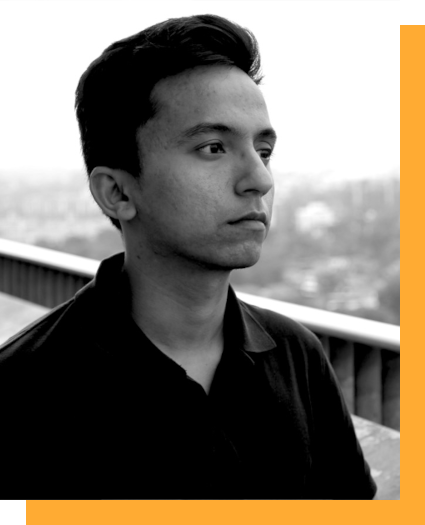
Hamid Roslan is a writer that has been described (on Goodreads) as a poet whose work “I didn’t fully understand”. Yet his work is certainly one that must be read, regardless of how ‘fully’ it can be understood.
His debut collection, parsetreeforestfire, was published by Ethos Books in 2019 and shortlisted for the Singapore Literature Prize in 2020. On its praise page, poet-critic Rachel Blau DuPlessis describes the collection as “a witty and accomplished book of Singlish poetry by Hamid Roslan, revved up with Singapore [sic] attitude” (Hamid, parsetreeforestfire 4). These descriptors struck my curiosity: is parsetreeforestfire really a book of “Singlish poetry”, and how should DuPlessis’ notion of a “Singapore attitude” be understood? (I write this not from a position of ‘academic gatekeeping’, but simply as a curious reader, which feels important as a starting point for engaging with Hamid’s work).
Hence, like most ‘top tier’ academics, I began with a Google search of reputable sources such as kiasuparents.com. (Most locals will understand how seminal this online resource is into understanding the Singaporean psyche). In a forum post, dated June 8, 2011, user dovetail remarks that:
My daughter loves poetry. She also writes whenever she feels inspired.
I don’t enjoy poetry .... Her classmates think she’s weird to love poetry. For me, I’m trying very hard to look interested. She read me Shakespeare’s sonnets, so cheem, I cannot take it.
(dovetail, kiasuparents.com)
From my perspective as a beleaguered Literature educator in Singapore trying to teach Shakespeare to 14-year-olds, dovetail’s sentiment about (Shakespearean) poetry reflects the general local perception of poetry as “cheem”, or inaccessible. From this alone, one might hypothesise that a collection of “Singlish poetry” would be more relatable. What might they think when presented with the second poem of parsetreeforestfire, excerpted as follows?
parching creation in advance
& searing guidelines to the sound of afound nation—in short…fundamentally
bankrolled & broiled with cooking methodto roast code, styled speech for vocabulary
regulation,[…]
to argot to world with protocol to communicate
—which is to say: criterion, or rule, orplunging dictum to conversation…or dogma, diction, or to
stake into discursive form a welt: doublespeak.(Hamid, parsetreeforestfire 17).
Before returning to my central line of thought, it may perhaps be worth examining these lines more closely. At first gloss, this is certainly a ‘cheem’ poem. Because of the semantic barrier its dense academic diction poses, what catches my attention first are other types of linguistic patterns; in particular, the insistent repetition of “to” and “or” that forms a pattern of deferral. Perhaps the assonant phrase “the sound of a found nation” (ironically suggesting chance discovery rather than a nation intentionally “founded”) hints at a search for a unified national identity. Yet the curious reader is met with two image-complexes in this search: firstly, of “cooking methods”: “charred”, “searing”, “broiled” and “roast”. And secondly, of bureaucratic control, as seen in “axiom”, “assumption”, “criterion”, “rule”, “doctrines”, “guidelines”, “protocol”, “administration”, “regulation”, and “canon”. Interestingly, there is a progression of this image-complex towards increasing rigidity, culminating in “dogma” and a final flourish of Orwellian authoritarianism: “doublespeak”. In short: Singapore = food and rules.
But why so “cheem”? This reminds me of the philosopher Nicholai Hartmann’s phrase “the hardness of what is real”, which neo-modern poet J. H. Prynne tries to explain in his essay “Resistance and Difficulty”:
All human action, Hartmann suggests, including physical movement and emotion activities such as expecting, hoping, desiring, valuing and so on, intend outward from the subject. … It is for Hartmann the resistance that these activities, radiating from the subject, encounter in the external world that is the chief source of our awareness of the world’s independent reality. The world becomes intelligible to us—that is to say we can discriminate between different aspects of its existence—by virtue of the fact that it resists our activities in various ways.
(Prynne, Resistance 27−8)
Along this line of thought I would rather boldly suggest that parsetreeforestfire is a collection that deals with the hardness of real language-as-experienced. Language, as the very medium through which we experience the world, encodes human action as both system and resistance. It furnishes the structures through which meaning becomes intelligible, yet simultaneously resists complete mastery at the individual level through its conventions, exclusions, and inherited social codes. Within this encoding emerges a sense of “welt” and “doublespeak”: a form of systemic stratification through which we are judged and marked by the linguistic circles we inhabit. We judge people based on how well they speak: for example, speaking Singlish at a government interview wouldn’t be ideal, wouldn’t it? Interestingly, according to the Chimbridge Singlish Dictionary, “cheem” is derived from the Hokkien word chhim 深, meaning “deep” or “profound”. This makes the term especially apt for Hamid’s poems: the lexical difficulty of Hamid’s poems perhaps reflect the experiential resistance embedded within comprehending language itself, compelling interested readers to delve beneath their surface to excavate deeper meaning.
But for those of you who have actually read parsetreeforestfire, you will accuse me of cherry-picking this poem to scare poor dovetail away. Its front matter states that it is “a bilingual book of poetry in which poems in Singlish occupy one side of the book, and poems in English in another. In her article on the status of Hawai'i Creole English (HCE) as a literary language (vs.. a literary dialect, which subsumes it to a non-standard variety of English), Suzanne Romaine remarks that:
Speakers of creole languages throughout the world have been discriminated against through educational and other policies which have denied the legitimacy of these languages, either in spoken or written form, as valid and important vehicles of cultural experience. (528–9)
To Romaine, writing in HCE becomes an “act of identity” and “a counter-discourse in which a different reality of otherness is constructed”. And this marginalisation of creole & pidgin languages such as Singlish and HCE is perhaps aptly captured by Hamid in poetic form in these lines in a subsequent poem: “Can / prosciutto prosecco cannot bakwa & beer. Can confirm go restroom but cannot go toilet … Cannot tell you what is home” (Hamid, parsetreeforestfire 28). Here, the insistent repetition of the modals “can” and “cannot” juxtaposes a binary of linguistic permission between the highbrow and the lowbrow, through which the speaker is ultimately denied the ability to define “home”. Language thus emerges as a gatekeeping force of identity legitimisation.
Now with this thought in mind, we return to “doublespeak”: where the ‘Singlish’ version of the poem-pair reads as follows:
Write statement for what? If write must
sign. Must appear on TV say sorry sorryAh Kong. Sotong. You think if you write
you must follow other people. If theymakan potato you swallow starch—huh
I cannot use starch? Should I cave into your force of habit, sight scanning
line swooning over turns & tricks?Ok. Statement is metaphor for tuition,
for textbook, for discount sticker labelat Fairprice. Use your brain. If got formula
we sure export lah bodoh. Kan dah kenabodoh. Don’t ask me for footnote. When
you read English you look up. They always
tell you speak up boy speak up
now I speak up.(Hamid, parsetreeforestfire 16)
There are striking thematic similarities to its sister poem, particularly in its repeated language of compliance (“must sign”, “Must appear”, “you must follow”), and the sense of lived language as spoken (“speak up”) rather than written, which echoes the search for “the sound of a found nation”. Yet this raises a crucial question: would a “coffeeshop uncle” find this “cheem”, or does it qualify, as DuPlessis suggests, as a genuinely “Singlish poem”? While colloquial phrases such as “lah” and “bodoh” foreground local speech patterns, the central couplets (“Should I … metaphor for tuition”) complicate this distinction, as the poem oscillates between markedly different linguistic registers, producing an almost dialogic tension between “proper” English and everyday Singlish speech. The poem therefore resists confinement within the singular sociolinguistic identity of “a Singlish poem”. Indeed, its self-reflexive references to “statement”, “formula”, and “footnote” perhaps expose the institutional pressures of linguistic standardisation that continually discipline and undercut colloquial speech.
It is perhaps interesting to contrast Hamid’s poem with the recently published collection Boh Beh Zhao (2025) by Cheng Him, blurbed on its cover excitingly by Gurmit Singh: “I can finally understand poetry. It is written as it should be — in Singlish”. His poem “After the Parent Teacher Meeting” echoes the propensity towards apology in Hamid’s poem above, but in a more quotidian context of an annual school parents’& teachers meeting:
ah seng lao bu
mouth only know
one world like that
kpop songsorry
sorry
sorrymy son
sorryah seng hear also pek chek
this kind of thing
why need to
sorry?ah seng ask his lao bu […]
(Cheng Him, Boh Beh Zao 8)
To the everyday reader, Cheng Him’s poem perhaps sounds closer to the vernacular Singlish heard at a coffeeshop, and one might hazard that this might make the poetry more ‘relatable’. Yet, in Ryan Yeo’s, perhaps inelegant, review of Boh Beh Zhao, he critiques Cheng Him’s Singlish as “uninteresting and unimmersive … ordinary scoldings that we would hear in an ordinary kitchen” and that the collection “often us[es] pedestrian Singlish to convey surface-level ideas”. Subsequently, Cheng Him took to Instagram to reply: “What then, is Singlish that is not pedestrian? What then, is the reviewer’s view of the form that non-pedestrian Singlish – Singlish Atas [trans. ‘high-class Singlish’] – so to speak, should take? (Cheng Him, “The Point of an Explosion”)? Perhaps Yeo’s narrow view then reflects Romaine’s point about creoles and pidgins being unfairly relegated to non-literary status.
From this debate, turning back to Hamid’s poetry, there arises two questions on my end: would Hamid’s poetry then qualify as a “Singlish Atas” poem, and does that mean Cheng Him’s poems are inherently more “readable”? Interestingly, in reviewing Boh Beh Zao, Chong Jin Gan remarks that:
When I first read these poems, I often found myself halted by words I didn’t recognise, or words that I did, but spelled out in unfamiliar romanisations, or whose meaning I was uncertain of.
(Chong, SUSPECT)
Could we not also say the same for Hamid’s poems? Even lines such as “If they makan potato you swallow starch” (Hamid, parsetreeforestfire 16) contain an implicit reference to the Singlish phrase “jiak kantang” (which combines Hokkien and Malay words to refer to being Westernised) that you may not catch unless you are familiar with Singlish expressions. So here, we then again circle back to the idea of Hamid’s poems foregrounding the resistance embedded within the linguistic circles that we inhabit; a non-Hokkien or a non-Malay Singlish speaker, such as I, would have trouble decoding parts of Cheng Him’s and Hamid’s poems. The use of poetic Singlish, in Hartmannian terms, then still resists the vernacular reader: there are no authoritative criteria, rules, doctrines, guidelines, protocols, regulations or canon to follow. Here, “resistance” operates in two intertwined senses: first, as the opacity through which language resists complete intelligibility; and second, as social resistance to institutional norms. Crucially, these forms of resistance are not entirely separable, since linguistic opacity itself can frustrate attempts at standardisation. As Singaporean playwright Alfian Sa’at succinctly puts it:
I think it's very important to recognise that there is no standard Singlish, and that the Singlish that we speak is going to be influenced by the kind of bilingual environment that we come from. So even though one might present Singlish as a kind of lingua franca that "could connect speakers across ethnic and socioeconomic divides", we should also be aware that there will be differences in the Singlish spoken by a Malay speaker, Chinese speaker or Indian speaker, mainly in the vocabulary used.
(Sa’at, Facebook, 14 May 2016)
And perhaps the collection is particularly self-aware of these problems of definition (which arises in the endless deferral of closed meaning that seems to permeate Hamid’s poems). And this awareness can be seen in one of Hamid’s later poems, which repeats and prints in bold what might be considered the stereotypical Singlish and colloquial Malay discourse particle, “lah”.
mosquito-squatting thighlah
impossible to miss heat percolatinglah
I would have moved if not for thelah […]
(Hamid, parsetreeforestfire 19)
Here Hamid seems to satirise reductive conceptions of Singlish as merely the addition of “lah” to otherwise standard English, revealing how such gestures flatten the cultural complexity that Singlish encodes. This sentiment is best expressed in a poem titled “to a mother who cannot singlish” by Wahid Al Mamun, written in Singlish:
ma I tell you how many time you cannot suka suka put lah after every sentence then call it singlish leh singlish quite cheem you know got grammar one singlish is language not rojak cannot eat one why you must talk singlish to the aunty downstairs sibeh malu leh ma your english very power already sia you go england get masters sia donnid singlish la hor aunty think you very atas already cannot speak singlish
(Wahid, Facebook, 13 Apr 2017)
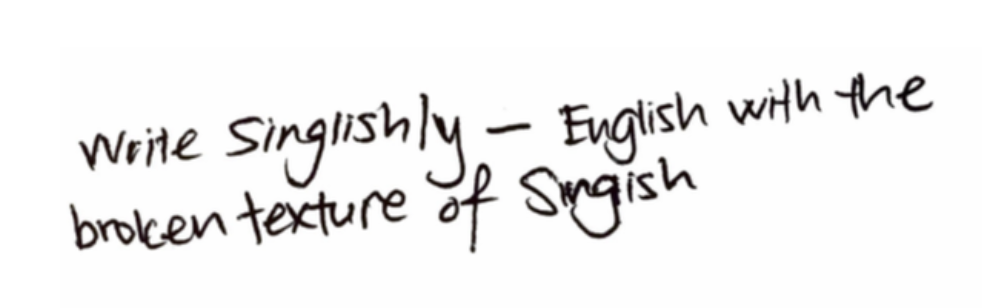
So, if parsetreeforestfire is not as certain of a “book of Singlish poetry” that DuPlessis claims to be, what is it then? Revealingly, Hamid writes in his notes that the collection perhaps reflects the attempt to:
(Hamid, in Hu, “Conversation”)
To do so seems to require both mastery of Singlish and English. As critics Ann Ang and Ian Tan point out:
Roslan’s collection invites readers to come as they are by accepting their inability to read. This challenges the assumption that language is meant to communicate, and that language users must master its usage, by way of accruing the cultural capital that is part and parcel of language learning.
(Ang and Tan, 27)
However, Ang and Tan’s comment on “master[ing language’s] usage” raises a question: must there be a benchmark that determines what counts as mastery of language? Is this search for certainty or mastery of meaning, in some sense, reflect what DuPlessis invokes as the “Singapore attitude” in her blurb for parsetreeforestfire? To me, the quintessential ‘Singaporean attitude’, if you asked random unsuspecting people on the street (source: me) is that of being ‘kiasu’, commonly translated as “afraid to lose”. A ‘kiasu’ reader might then Google every unfamiliar word to mine every single ore of meaning from these poems. But as Hamid remarks at the launch of parsetreeforestfire, “we do too much explaining what happens in this country. We need to stop doing that. Stop explaining ourselves” (“crazy”).
Indeed, Hamid’s poems seem to take a stance against the footnote as authoritative source of meaning, resisting the impulse to fix readers’ interpretation through authorial explanation. The first poem above already states clearly, “Don’t ask me for footnote.” (Hamid, parsetreeforestfire 16). Later, a subsequent poem remarks “Also tak perlu [trans. ‘unnecessary’]: your footnote,” (20), and in another, the haunting line “the footnote will calmly bury them all” (27). These are at first glance, ironic, because the third section of the collection, “forest”, is chock full of footnotes. Yet these footnotes, written in snarky Singlish, upend the expected academic authority of the footnote through humorous, irreverent commentary. One of my satirical favourites is as follows:
The act of speaking is only powerful if the speaker is in
control. & if the speaker does not know that this language is faulty, then
the speaker has been secretly muzzled.¹⁰
__________________________________________¹⁰ Speak no use. Ask & ask for footnote. Nowadays got so many way to know.
Thought got Google? Last time no Google you know. Backside so fat cannot
go computer & type? Got phone don’t want to use? Data all keep for Korean
drama is it? Got man wake up from coma, you steam. Then you pay big big
telephone bill. No wonder got simple problem like this ang moh lang speak
twist & turn.(Hamid, parsetreeforestfire 57)
Throughout Hamid’s collection, there is a keen reaction to the centralisation of language and its regulation by authoritative norms, whether through the academic footnote or the colonial standard of English. As point 18 in “tree” aptly remarks, “This faulty language must first be unshackled from this center” (60). The “ang moh lang” is at once demonised and satirised, with the corresponding footnote reading “18 Ang moh lang must be quite shiok hor, use one sentence talk like very big but actually say same thing. Never puasa [trans. ‘fast’] before”. Yet, beyond the satire, throughout this section, there are broad postcolonial and historical strokes—mentions of Ah Kong (a nickname for Lee Kuan Yew), René Descartes, who posited that language is the defining characteristic of human thought, and works such as Edward Said’s Orientalism (1978) and Syed Hussein Alatas’ The Myth of the Lazy Native (1977)—that give Hamid’s work a certain biting learnedness, possibly cultivated at Yale-NUS, where this manuscript served as his capstone project, supervised by lecturer, poet and essayist Lawrence Ypil.
Here, then, I find it apt to ask about what seems to be the central deliberation of Hamid’s first collection: what does it mean to “unshackle” language itself from any authoritative or authorial centre? The final section, “fire”, perhaps comes closest to this Babelian attempt. It is presented as a singular, centre-aligned column of prosaic text without conventional sentence syntax, running across six pages. Hamid, in his notes, reflects on the inexplicable genesis of this “most difficult [section] to write”, as “Wanton permission? Who knows.” (in Hu, “Conversation”). To give you a sense of this inexplicability, the ending segment is excerpted below:
thus hopelessly lost, navigating
aphasia to Latin root & talk talk
tree, spoken turned inward like
a sock, sharply English—this this
this is the found interrup— this is
—ted finally allowed to wallow,
smother—winning divine bet:
masticating past loquacious
throat, securing future: YANG
DI-PERTUAN NEGARA a mat
significant, I’m-possible, never
again on seas, & final-ly-ly-ly-
ly-ly ly ly ly ly ly ly ly ly ly ly ly ly
ly ly ly ly ly ly ly ly ly ly ly ly ly ly
ly ly ly ly ly ly ly ly ly ly ly ly ly ly(Hamid, parsetreeforestfire 91)
The loss of speech, “aphasia”, is a recurring motif in these poems (here I recall these striking lines elsewhere: “split the tongue tip to throat” [27] and “Look: it has / sliced off its tongue / to show you how” [31]). We also see the juxtaposition between the academic, etymological diction of “Latin root” —language studied and systematised—versus the colloquial, child-like “talk talk tree”, which might gesture at how language is acquired through use. To investigate language is perhaps to “tur[n] [it] inward like a sock” (which to me this metaphor reads as a self-defeating gesture), and the image-complex formed by the diction “wallow”, “smother, “masticating” perhaps hints at the excessive overconsumption of “loquacious” language. Impossible naively becomes “I’m- possible”, leading to the sequence’s final collapse into phonetic fragments of sound.
In this sense, Hamid’s work can be situated within a broader field of experimental language poetry, a sense that also perhaps surfaces in later Singaporean works such as The International Left-Hand Calligraphy Association (2022) by Tse Hao Guang and Eke (2025) by Wahidah Tambee, not as direct lines of influence but as novel parallel developments exploring the limits of linguistic form. Interestingly, speaking about the formation of “new poetic thought”, the poet J.H. Prynne remarks in a lecture that:
[Poetic work is not] the personal history of someone thinking, the efforts of conscious mind-focus as pursued by an individual subject, or even an individual poet . . . but is self-disputing and intrinsically dialectical. What thereby vibrates on the page and in the mind of the reader, in knowledge and memory and moral understanding, this does not belong to the poet, not anymore; it does not belong in the domain of the language system, not anymore; it does not reside in the fabric of dispute about values or competing models of state control, or visions of a future life . . . These are the outer shells of a dialectic energy working through the methods of poetic composition which cannot be defined or contained by its shells but must break them to become altogether new: new poetic thought.
(Prynne, Poetic Thought, 599)
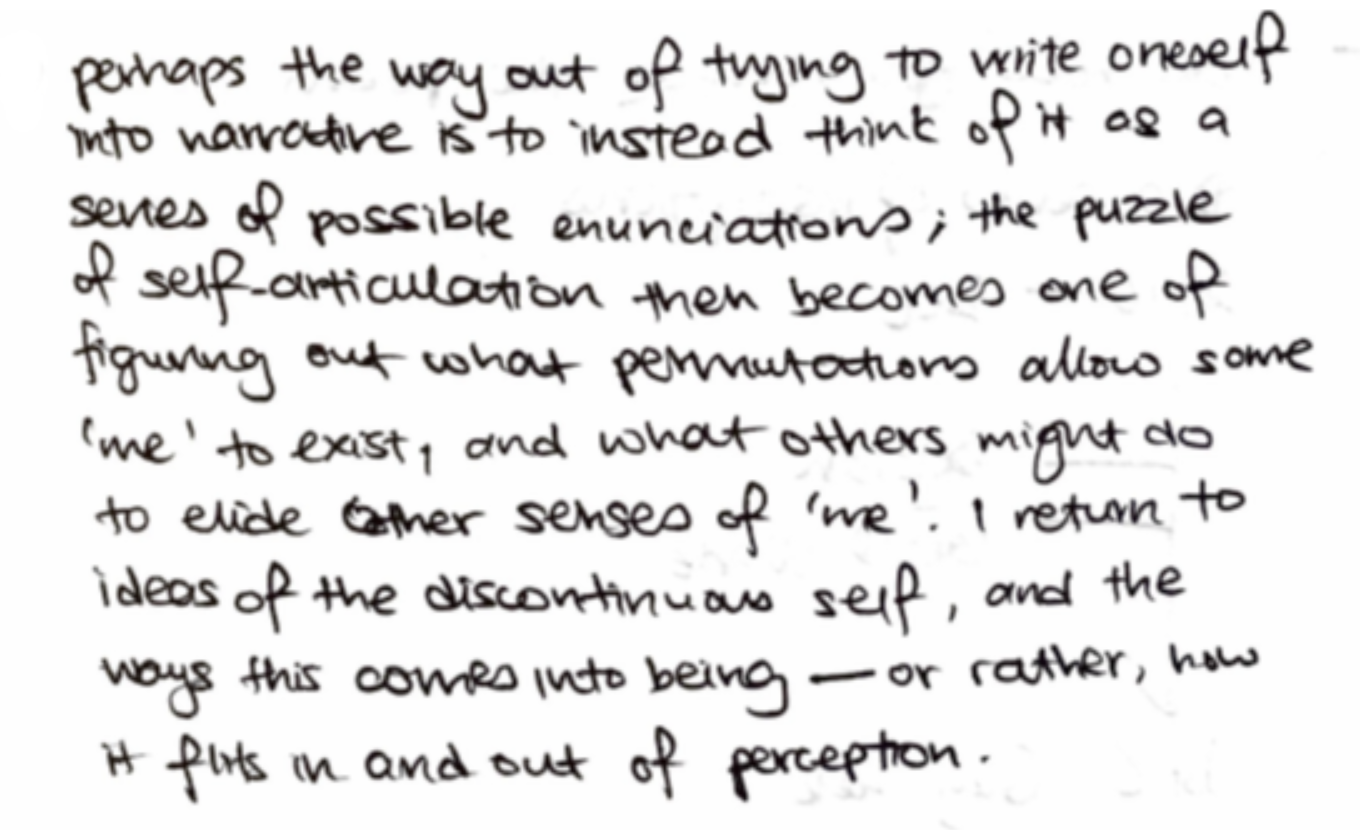
Is Hamid’s work, then, an instance of such “new poetic thought”, one that seeks to break from both authorial control and the authority of the language system? Curiously, he remarks in his personal notes that:
(Hamid, in Hu, “Conversation”)
Hamid’s own reflection on the “discontinuous self” is conceived as permutation: a series of shifting “possible enunciations” which no longer serves to stabilise identity but instead allows it, dialectically, to flicker in and out of being. This, perhaps, is the conceit of parsetreeforestfire, where readers are invited to excavate meaning: finding what is familiar and unfamiliar, and in the process recognising their own exclusions from, and inclusions within, the circles of language in which they inhabit.
Three years after parsetreeforestfire was published, in 2022, Hamid exhibited a chapbook titled in all the places i could not find you at the Pratt Institute. Reflecting on its genesis, he remarks that:
On Oct 1, 2021, I saw Raden Saleh’s ‘Fighting Tigers over the Body of a Javanese Man’ at the Upper Belvedere in Vienna and was promptly haunted by a man who died in 1880. Following that encounter, I kept a series of notebooks in which I spoke to Raden Saleh through my writing, and copied his paintings and drawings, and the portraits that survive of his likenesses. He guided my hand, and my life, it seems, over that year, but committed no words of his own to my pages.
(Hamid, Unbound)
If parsetreeforestfire works to disperse the self through a series of permutated enunciations, in all the places i could not find you (2022) seems, at first glance, to move in the opposite direction: towards inhabiting another, staging a sustained conversation with the dead Raden Saleh. Yet even here, the self is not restored so much as reconfigured, mediated through the presence of Raden Saleh, who “guided [his] hand” but “committed no words of his own”.
It is perhaps salient to view this collection through the lens of the “spectre”—“the ‘shadowy third’ or trace of an absence that undermines the fixedness [of] binary oppositions”, as scholar Jeffrey Weinstock suggests—which is discussed in the writings of poststructuralist thinkers such as Freud, Deleuze, Derrida, and Agamben. For Derrida, “the spectre gains its body or in-corporeality in the world via the insistence or return of forgotten or alternative histories, [and] unfulfilled debts” (Delairre 5). In Hamid’s work, the binary oppositions are self and Raden, living and dead, and history and forgetting; yet these binaries are persistently undone, as presence is mediated through absence, and the persona’s self emerges only in relation to what is no longer there.
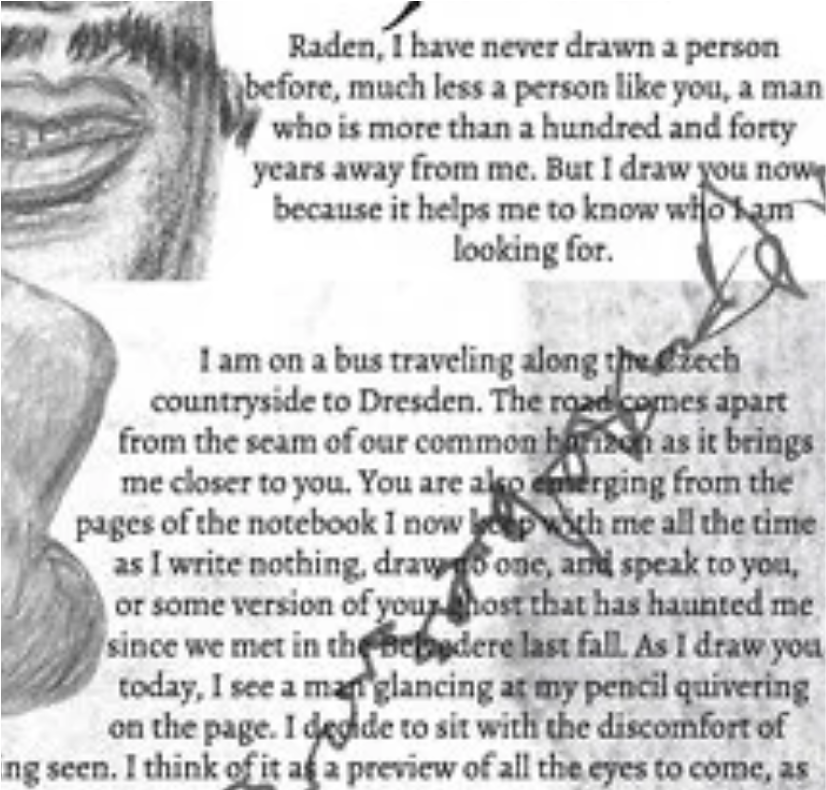
(Hamid, all the places)
Indeed, in all the places i could not find you reads as an autobiographical account, almost journal-like. It begins with an apostrophe to the dead Raden, before quickly unsettling that apparent immediacy: Raden appears not as a stable figure but as “some version of [a] ghost” that has “haunted” the speaker. The act of writing is likewise destabilised (“as I write nothing, drawing once, and speak to you”) suggesting that meaning is not produced through inscription but through the act of address. The figure of Raden is initially held at a distance marked by temporal disjunction (“more than a hundred and forty years away from me”). Yet, it seems to demand attention in the present, subverting time (“since we met last fall … today, I see a man”) and finally ‘ending’ (if an ‘end’ could be found) with the following binary sequence of words:
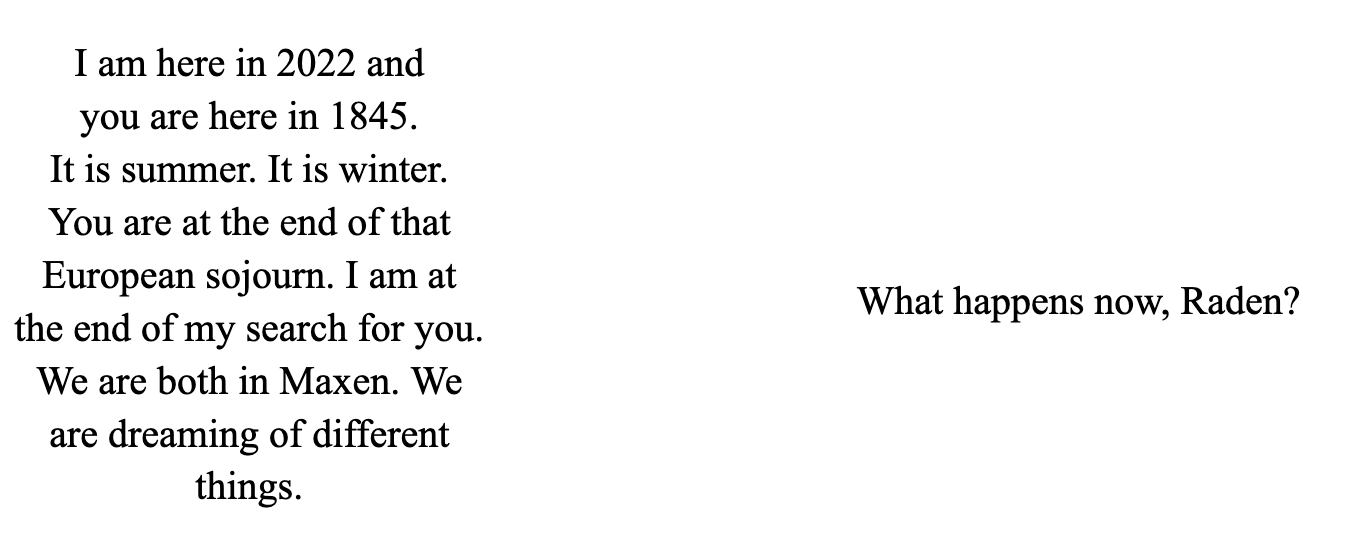
(Hamid, all the places)
What remains at the end is not closure, but a question of what comes next. As Ian Delairre argues, the spectre “issues forth a demand as history that subverts time by producing a future-conditional” (5). The persona’s journey is not simply the recovery of Raden Saleh-as-historical-figure, but the transformation of that figure into a “dream”—an unresolved demand. Raden’s presence is neither fully historical nor fully imaginary but persists as something that must still be encountered. The encounter thus does not restore Raden’s past self; indeed, at the bottom of each folded page, fragments of autobiographical data on Raden appear, but are mirrored, sometimes even obscured by Hamid’s drawings, which unsettles the authority of historical knowledge (a thread we also find in parsetreeforestfire). Raden-as-spectre & the autobiographical persona are rendered as a discontinuous self, contingent on this act of direct address. The spectre of Raden is unable to alter the past or control the future; he can only haunt. “To haunt does not mean to be present”, maintains Derrida. It is “to answer for the dead, to respond to the dead” (Spectres 136; 202, emphasis Derrida).
The insistence of the Derridean spectre on forgotten histories is then excavated through the persona’s recognition that “it seems you weren’t important enough for history”. This prompts the journal-like act of searching—“I tried to look for you in the archives”—culminating in the sombre, laconic line, “People like us are annihilated all the time” (Hamid, all the places). The blunt force of the diction of “annihilated” exceeds mere forgetting but suggests total erasure. This brings to mind the work of the postcolonial theorist Achille Mbembe: in “The Power of the Archive and its Limits”, he remarks that the conventional historical archive “is fundamentally a matter of discrimination and of selection” (20), and functions as a metaphorical “sepulchre” or burial site, in which traces of the deceased are laid to rest so to prevent them from “acquir[ing] a life of their own”. In this way, the conventional archive operates according to a logic in which “the dead should be formally prohibited from stirring up disorder in the present” (22).
Yet, it is this very failure of the archive to contain Raden Saleh that triggers the haunting of the persona in in all the places i could not find you. As Hamid’s persona remarks, his journey is haunted by “my unhealthy obsession with / a ghost who kept walking / on and on”. Yet the chapbook proceeds not as an act of excavation but through approximation. The persona remarks that “I take all of your bodies out of hiding, and / choose the most elaborate version of you to copy”; he “copied / van Dyck / and Rubens / at the gallery / with tireless / diligence”, and tries to “recreate a few photographs of your / Hüsli that I found in the archives, but it is impossible to line up the / shots”. Here the work does not claim transparent access to the past, but visually, through its extensive visual matter and drawings, foregrounds the labour of trying: the distortions, and illegibilities through which history is made, and through which it continues to resist being fully known.
The literary text, as Jean-Michel Rabaté writes in The Ghosts of Modernity, is “systematically ‘haunted’ by voices from the past … [which] shows in an exemplary way the ineluctability of spectral returns” (xvi). And this ineluctability is perhaps sensed in Hamid’s persona’s reflection near the end of his European journey:
[…] And how strange
is it that I am led by an instinct that is not
my own, is it your will? Or what I think of as
yours? My body wearing your clothes. For so
long I have thought of you, written to you,
held your presence in my mind’s eye, and my
heart gripped by your certain death at the
end of the 19th century, I feel all of this. All of
my language is attuned to you, and it is only
possible to say this now because I can
no longer deny it. I am feeling my way back into
your presence in ink. […](Hamid, all the places)
Here, language does not belong to the persona but is simply “attuned” by the other, such that writing becomes a process of “feeling” towards a spectre that can neither be fully recovered nor inhabited (like “wearing your clothes”), only mediated through the act of haunting post “certain death”. If Hamid’s central deliberation in his collection is what it means to “unshackle” language itself from any authoritative or authorial centre, then his chapbook extends this inquiry: not by returning language to the self, but by relocating it within a relation to the other, where voice emerges only through spectral mediation. As Hamid writes in parsetreeforestfire, “there are as many ways to speak . as the mouth is able to / haunt itself. (25−6)
Hamid’s work is a voice that needs to be read. Circling back to the initial forum post by dovetail I cited, jamestancx997 replied that:
I am very happy that your child has this inclination.
Give her poetry by Robert Frost, Seamus Heaney, Michael Longley, Emily Dickinson, John Keats, Elizabeth Barrett Browning, Robert Browning, Matsuo Basho, e.e. cummings (yes his name is written like that, with no capital letters), and Edith Wharton, to name but a few.
(jamestancx997, kiasuparents.com)
Ambitiously, as a counterpoint to this Western-centric ‘canonical’ list, I would also add Hamid Roslan, whose work, as Shawn Hoo argues, both emerges from and unsettles earlier linguistic formations such as Engmalchin and Singlish poetics, rejecting their realist or “authentic” tendencies in favour of a more experimental “Singlish Modernism” (Hoo). And perhaps, as we read Hamid, we might find ourselves more “sensitive to what is lost, but also to what is gained”. (Hamid, in Hu, “Conversation”)
Works Cited
Alfian Sa’at. “I think it’s very important to recognise that there is no standard Singlish…” Facebook, 14 May 2016.
Ang, Ann, and Ivan Tan. “The Poesis and Politics of English-es in Singapore: Intersubjective Worlding in the Poetry of Joshua Ip and Hamid Roslan.” ELH: English Literary History, vol. 89, no. 2, 2022, pp. 547–573. https://doi.org/10.1353/elh.2022
Cheng, Him. Boh Beh Zhao: Poems. AFTERIMGAE, 2025.
———. “The Point of an Explosion” Instagram, 3 Nov. 2025
“Chim.” Chimbridge Dictionary of Singlish and Singapore English, Singlish Dictionary, https://singlishdict.app/?q=chim. Accessed 23 June 2026.
Chong, Jing Gan. “A Map with No Lines: Reading toward Meaning in Boh Beh Zhao.”, Singapore Unbound, 13 Mar. 2026, singaporeunbound.org/suspect-journal/2026/3/13/a-map-with-no-lines.
Delairre, Ian. “Derrida and Agamben: Spectrality, Contemporaneity, and the Role of Intellectuals.” Academia.edu, Dec. 2013, www.academia.edu/5530751. Accessed 25 May 2017.
Derrida, Jacques. Specters of Marx: The State of the Debt, the Work of Mourning, and the New International. Translated by Peggy Kamuf, Routledge, 2006.
dovetail & jamestancx997. “Kid’s who love poetry.” KiasuParents Forum, 2011, forum.kiasuparents.com/topic/22924/kid-s-who-love-poetry/21. Accessed 21 Mar. 2026.
Hoo, Shawn. “Singlish Modernism.” Asymptote Blog, 29 Oct. 2020.
Hu, Bettina. “I Am Speaking Full of Dirt—In Conversation with Hamid Roslan.” Ethos Books, 18 Aug. 2019, www.ethosbooks.com.sg/blogs/news/i-am-speaking-full-of-dirt-in-conversation-with-hamid-roslan
———. “It Gets a Bit Crazy Lah—The Launch of parsetreeforestfire by Hamid Roslan.” Ethos Books, www.ethosbooks.com.sg/blogs/news/parsetreeforestfire-launch. Accessed 21 Mar. 2026.
Mbembe, Achille. “The Power of the Archive and Its Limits.” Refiguring the Archive, edited by Carolyn Hamilton, Verne Harris, Jane Taylor, Michele Pickover, Graeme Reid, and Razia Saleh, Springer, 2002, pp. 19–27. https://doi.org/10.1007/978-94-010-0570-8_2.
parsetreeforestfire. Goodreads, www.goodreads.com/book/show/52549774-parsetreeforestfire. Accessed 21 Mar. 2026.
Prynne, J. H. “Poetic Thought.” Textual Practice, vol. 24, no. 4, 2010, pp. 595–606.
———. “Resistance and Difficulty.” Prospect, no. 5, Winter 1961, pp. 26–30.
———. “The Art of Poetry No. 101.” Interview by Jeff Dolven and Joshua Kotin. The Paris Review, no. 218, 2016, pp. 174–207.
Rabaté, Jean-Michel. The Ghosts of Modernity. University of Florida Press, 1996.
Reeve, N. H., and Richard Kerridge. J. H. Prynne: The Oval Window: A New Annotated Edition. Bloodaxe Books, 2018.
Romaine, Suzanne. “Hawai'i Creole English as a Literary Language.” Language in Society, vol. 23, no. 4, Dec. 1994, pp. 527–554. Cambridge University Press.
Roslan, Hamid. in all the places i could not find you. Singapore Unbound, 1 Apr. 2023, singaporeunbound.org/suspect-journal/2023/4/1/in-all-the-places-i-could-not-find-you.
———. parsetreeforestfire. Ethos Books, 2019.
Wahid Al Mamun. “to a mother who cannot Singlish.” Facebook, 13 Apr. 2017.
Weinstock, Jeffrey Andrew. Spectral America: Phantoms and the National Imagination. University of Wisconsin Press, 2004.
Yeo, Ryan. “When Every Explosion Looks the Same.” Quarterly Literary Review Singapore, vol. 24, no. 4, Oct. 2025, www.qlrs.com/critique.asp?id=2000.
