Anita Patel (b. 1959)
BIOGRAPHY
Anita Patel is a Canberra writer who was born in Singapore. Her two collections of poetry are Petals Fall (Recent Work Press, 2022) and A Common Garment (Recent Work Press, 2019).
Her poems are included in the anthologies: What We Carry (Recent Work Press), Australian Poetry Anthology (Volume 8, 2020), Not Very Quiet: the Anthology (Recent Work Press), This Gift, This Poem (Puncher and Wattman), These Strange Outcrops: Writing and Art from Canberra (Cicerone Journal) and The Book of Birds (Recent Work Press). Her work also appears in publications such as: Cha: An Asian Literary Journal, Mascara Literary Review, Cordite Poetry Review, Not Very Quiet, Demos Journal, Backstory Journal, Other Terrain Journal, Pink Cover Zine, FemAsia Magazine, Plumwood Mountain Journal, Cicerone Journal, The Blue Nib Literary Magazine (Print Issue 42), Eucalypt: a tanka journal and Australian Book Review. Her early work was published in The Canberra Times, Summer Conversations (Pandanus Press, The Australian National University), Block 9 and Burley Journal.
Her children’s poems are included in the anthology, Pardon My Garden (Harper Collins). Her poem “Women’s Talk” won the ACT Writers Centre Poetry Prize in 2004. Her poetry was selected for and published in Australian Book Review’s States of Poetry ACT - Series Three (2018).
She collaborated with artist Annie Franklin to produce three books: Heart Stitched (2019), Grief and Beauty (2022) and Familiar Fragments (2025), and was the guest editor for Issue 2 of Not Very Quiet. She has performed her work at the National Folk Festival, Poetry on the Move Festival (University of Canberra), Queensland Poetry Festival and That Poetry Thing (at Smith’s Alternative). She has also read her work at bookshops such as Word in Hand, Glebe and Book Bar, Singapore.
PERSONAL ADDENDUM
I can’t remember a time when I did not try to make words appear on paper, on pavements, on walls and even on shower screens (which is not a good idea). And I can’t remember a time when I have not been able to read. If you can read—you will never be lonely because you will always have a writer’s voice telling you a story and for me it’s all about the story.
When I was about eight years old, I started sending scraps of my writing to local newspapers in Singapore. The thrill of seeing my childish words in print was glorious and when I came to Australia as a teenager, I continued to send my writing (which occasionally got published) to newspapers in Australia. But I never really thought that I would be a properly published writer because every migrant child knows—writing is a hobby, it is not a job.
So, I became a teacher, and I loved teaching literature and creative writing. I was so busy teaching, running a household and bringing up my children that my own writing sat on the back burner. Isn’t that that the way for so many women? I had a couple of children’s poems published by Harper Collins in an anthology, Pardon My Garden, in the early 90s and I had a few pieces published in The Canberra Times and in some literary journals. In 2004, my poem, “Women’s Talk”, won the ACT Writers Poetry Prize which I never expected, and which boosted my confidence for a little while, but I never really thought of myself as a poet. When I retired from teaching, I started to write a blog (teapotsandincense.wordpress.com) and that was a lovely way to share my bits of writing with friends and family on social media.
So how did I break through into the community of Canberra writers?
I credit my success (such as it is) to a few significant people and some lucky circumstances for which I am very grateful. These people include: the Persian Australian poet, Niloofar Fanaiyan; Jen Webb, Distinguished Professor Emerita of Creative Practice at the University of Canberra (who selected my poetry for Australian Book Review’s States of Poetry ACT - Series Three, 2018); Moya Pacey and Sandra Renew founding editors of Not Very Quiet (who gave me the opportunity of guest editing issue 2 of their journal); and Shane Strange, publisher at Recent Work Press (who published my two collections of poems).
My poetry comes from lived experience and ordinary moments—from connections with nature, with people, with objects and places. Heritage, mythology, family and history all find their way into my poems. This is often the way for many of us who migrate from one world to another. Many of my poems “pay tribute to the yearning of a migrant heart and the search for home. This is poetry that peers through the cloudy lens of memory to examine the tattered web of relationships, language, landscapes and stories which make up a self.” (taken from the blurb on the back of my second collection Petals Fall).
My favourite quote about poetry is by Carl Sandburg: “Poetry is the achievement of the synthesis of hyacinths and biscuits.” The exquisite and the prosaic are all part of the poetic experience.
One of the things that I love about writing poetry is that a poem often turns up when you least expect it. Pablo Neruda describes it best when he says: “… poetry arrived / in search of me… I don't know where / it came from, from winter or a river. / I don't know how or when.” This is the irresistible mystery of poetry for me. That first line arrives, and we don’t know where it will take us or even if it will survive in the final work.
The other thing that I love about poetry is that it allows me to break all the rules of literal language. Poetry makes no sense, but it makes all the sense. This is because the language of metaphor is a wondrous thing. It allows us to express the unsayable. I am always excited by an image in which two things collide and collude simultaneously allowing us to see something familiar in a new, refreshing and startling way.
I also simply love words—and poetry is all about making words sing perfectly together.
Honing a poem is a joyful task. There is no place for even a slightly wrong syllable in poetry. Every single word matters.
Most of all, I love the way that a poem works itself into your heart and stays there forever. I am always astonished at what a poem finds in me. And I thank the scores of poets who have shared their words with me.
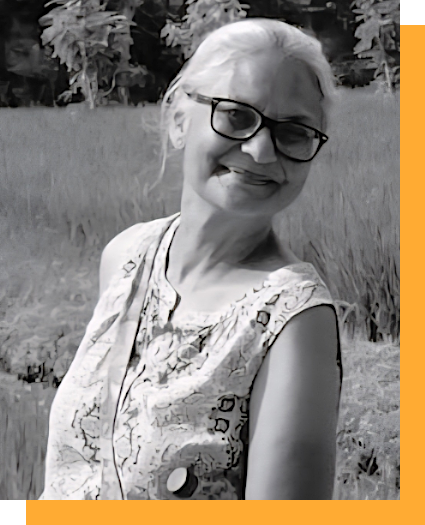
Author Photo and Biography © Anital Patel. All rights reserved.
