
Anita Patel (b. 1959)

CRITICAL INTRODUCTION
Written by Jayanthi Sankar
Dated 31 Mar 2026
Anita Patel was born in Singapore of Indian and Eurasian heritage. She now lives in Canberra, Australia. Patel is the author of the poetry collections A Common Garment (2019) and Petals Fall (2022). She has performed her poetry widely, including at the Queensland Poetry Festival and the Poetry on the Move Festival (University of Canberra). Her poetry illuminates—through layered reflections on time—the complex intersections of race, power, language, and landscape. Patel’s poetry suggests that cultural knowledge, much like culinary tradition, is perpetually susceptible to both erasure and reclamation. This theme recurs throughout her work, resonating deeply with experiences of migration across the globe.
Patel’s poems span a wide range of settings—from intimate domestic spaces to extraordinary landscapes. In the poem, “Cooking Rice” from A Common Garment (2019), the speaker (a newlywed Asian wife who has been given a rice cooker) reveres Dewi Sri the rice goddess; she describes the process of rice grains reaching the fire from the fields, perhaps, signifying also the Hindu marriage ritual where puffed rice is offered into holy fire by a new bride. In the following lines, she depicts the goddess walking barefooted through rice fields and connecting to the roots of seedlings:
As I measure out the grains with precision
into a plastic cup (included for this purpose),
Dewi Sri the rice goddess wends her way through
padi fields—stepping
daintily among newly planted seedlings—
As I add water carefully (just enough),
Her naked feet splash in tepid
mud and ular sawah (rice padi snakes) slither
across her bare toes …(“Cooking Rice”, A Common Garment, 2019)
This resilience spans the passage of time and memory. Having lived across Singapore, Malaysia and Australia, Patel’s “My Daughter Looks Like Your Daughter” in her second collection Petals Fall (2022) transports the reader to the tense atmosphere of Japanese-occupied Malaya. With a remarkable economy of language, Patel evokes the unspoken terror faced by women and girls when a soldier would appear at the door. Her speaker describes:
When the officer with a samurai sword arrives, my older sisters scuttle
into hiding(“My daughter looks like your daughter …”, Petals Fall, 2022)
Yet, in a moment of startling empathy, the soldier—upon seeing a child—remembers his own daughter back home in the visual created.
He pulls a photo out of his wallet. My daughter—looks
like your daughter.(“My daughter looks like your daughter …”, Petals Fall, 2022)
The poem delicately balances vulnerability and shared humanity against historical violence. Tenderness for a child is balanced against the spectre of sexual violence against women.
Patel portrays the inner resilience of women as they navigate shifting geographies and identities, principally from a Singaporean or Malaysian context to an Australian one. Some of her work (such as the nostalgic poem, “Tau Suan”) explores complex relationships including those between parents and children.
tau suan brought home carefully
for a sleeping eight year old
waiting in the darkness
for the crunch of yoo char kway
in pandan fragrant syrup and the smell
of her mother’s fancy cigarettes …(“Tau Suan”, A Common Garment, 2019)
Patel is able to evoke a memory of childhood through the figure of the child and olfactory images. The aroma of tau suan and yoo char kway, emblematic of dishes accessible in Singapore, blends with that of the speaker’s mother’s cigarettes, implying one way of managing stress. Patel’s figures give a sense of the trajectory of womanhood, from marriage to motherhood.
Food, cooking, and recipes recur as structuring motifs across her oeuvre—not merely as cultural signifiers, but as epistemological tools through which identity, gender, and history are explored. Patel’s body of work, rich in nostalgia, identity, and cultural nuances, seamlessly weaves together the sensual and the political, the mythic and the everyday.
Culinary and Cultural Narratives in A Common Garment
Patel’s first collection, “A Common Garment” (2019), draws on the ordinary—teacups, sweets, spices—as entry points into complex negotiations of identity, memory, and belonging, as evidenced in the collection’s titular poem:
In the candy pink hush
of this room—we gather around
a table scattered with teacups,
scruffy magazines and an
unfinished jigsaw puzzle …
On the television Cyclone Debbie
wreaks havoc—palm trees bend in half[…]
Unified by our common garment
(pink and white)(“A Common Garment”, A Common Garment, 2019)
A table set with teacups becomes a space for women to share stories and fears.
One of Patel’s key concerns is what survives the experiences and processes of migration, whether physically or intangibly. In “Family Tree”, Patel traces the multi-generational arc of migration, along with the dislocation that often shadows the diasporic pursuit of identity:
leaving no footprints
in the dust of his village
(or was it a town?)
bringing nothing—not a single
memory, not a song or story or
word of his language—
arriving without baggage(“Family Tree”, A Common Garment, 2019)
The poem dwells in the specificity of memory: ripped-up roots, crumbling leaves and bark—spontaneous metaphors for the migrant state of mind, evocative of the last memories carried by a migrant on leaving their home village.
One of the most affecting poems in the collection, “Bereft” exemplifies Patel’s restraint. She describes her speaker in the process of editing text on a computer:
tapped out
on a salt wet keyboard—(“Bereft”, A Common Garment, 2019)
The tactility of the “salt wet” keyboard could suggest that the editor is sweating from exertion and humid weather, but it could also suggest tears dripping, the expression of feeling emotionally “bereft”. With a sparse palette, Patel renders grief as a quiet, continuous presence—emotionally weighted, yet never sentimental.
Bereft:
in Garamond, Castellar and
Déjà vu
in Lucida Calligraphy and
Arial and Century Schoolbook,
in purple Wide Latin size 72 …
then shrinking slowly,
inevitably back
into the dark finality
of size 12 Calibri black …(“Bereft”, A Common Garment, 2019)
There is a metatextuality at work, with the suggestion that the emotional state of feeling “bereft” is carried into poetry, expressed in various font sizes and colours before settling into a more conventional presentation.
In “Your Voice”, the words “bawang”, “blachan”, and “jintan” become “nomadic syllables (held somewhere in my mouth and heart) wafting among the pots and pans— / sizzling the air with their fragrance”. Here, Patel incorporates the culinary vocabulary of the Malay world, the accentuation of pastes, spices, and scents evoking a sense of the texture of diasporic life. From a thumb-sized amount of ginger to a ring-top can of coconut milk, the poem maps a sensory journey, foregrounding the physicality of memory and the palpability of cultural retention.
“That’s Their Story” takes on patriarchal myth with a defiance. The poem’s closing lines mark a pivotal moment:
but I’m just not buying it
no matter how many Shivas tell me
that it’s true.(“That’s Their Story”, A Common Garment, 2019)
Patel’s speaker resists the internalisation of dominant narratives and seeks to reclaim interpretive agency. Without the words given in parentheses, the poem might lean toward resignation about the red stripes painted on walls of the temple. Instead, Patel’s speaker describes:
(red is the impurity of
women’s blood, white is the purity
of semen)(“That’s Their Story”, A Common Garment, 2019)
And, in those lines, it stakes a quiet yet firm feminist claim and critique.
In “Fried Bread and Mango Juice”, dedicated to her paternal grandmother, Patel reflects on the limits of sensory experience in old age. Here, taste becomes less about present sensation and more about memory.
I have had eight decades of eating
and now my dry mouth tastes nothing—
but in the stillness of my dreams
I feast like a child
on fried bread and mango juice …(“Fried Bread and Mango Juice”, A Common Garment, 2019)
As time progresses, experience becomes increasingly curated through remembrance, reliant on secondary memory as a form of inheritance.
“Sita” offers a reimagining of a popular epic in Hindu tradition. Ram is the protagonist in the epic Ramayana, and Sita is his wife. He compelled her to step into a fire to prove her chastity after she was held in captivity by the antagonist Ravan. This is representative of ancient views about the significance of a woman’s chastity for her family, clan and kingdom. Patel presents Sita not as a passive figure of endurance, but as a woman with her own voice, agency, and yearning. The poem begins with questions directed at Sita concerning whether Ram ever truly saw or sought to understand Sita:
Sita—when you followed
your blue skinned lover
along tangled forest paths
Did he marvel at your fearless laughter
filling the darkness with hope?
Did his heart lift at the sight of you,
his sure-footed wife
marching melodically into the wilderness
on bell garlanded feet?(Sita, A Common Garment, 2019)
Patel not only challenges traditional depictions of Sita and womanhood in its entirety, but subverts hegemonic readings of classical texts, reasserting narrative space for female subjectivity.
Poetry of Heirlooms, Nostalgia, and Growing Up in Petals Fall
When Patel’s second collection Petals Fall opens with the poem “Vanished”, we get to feel the passing of decades. With time comes ease in a new home or marriage, and from that ease emerges a deeper way of thinking. “Vanished” is a poignant meditation on a wedding dress that mysteriously disappears, much to a mother’s consternation. More than a missing garment, the dress becomes a metaphor for the intangible threads binding generations:
for a cherished daughter
who did not share her sorrow
at this loss—but gratefully
received the empty, teak hard
box carved with galloping
horses, swaying trees and
boatmen crossing a stormy river.(“Vanished”, Petals Fall, 2022)
Heirlooms such as these carry an energy that transcends their material form. Often worn only once, a wedding dress is preserved in memory and in photographs, as though suspended in time. The perpetual echo of matrilineal memory (like waves returning to shore) is captured in the rhythm of this poem.
of Italian lace and pale pink ribbon
(reminiscent of handmade
party frocks from my childhood)
She had folded it carefully into
a Chinese camphor wood chest
(owned by her mother)(“Vanished”, Petals Fall, 2022)
In “Cracked”, Patel dwells on time through the traces it leaves behind, metaphorically. People may depart, but the ordinary objects of daily life—cups, handles, bowls—retain the imprint of their touch. Her speaker says in the opening lines:
My grandmother’s mixing bowl cracked
on the first day of lockdown. I mended it as best
I could, but I knew that it would never again
endure a robust beating with mixer or wooden spoon.(“Cracked”, Petals Fall, 2022)
These objects become repositories of memory, delicate with meaning, preserved as much for their emotional freight as for their function.
A similar sentiment is expressed in “Tempting Providence”, a tender portrait of a grandmother’s protective love which is steeped in superstition. Her wishes for her grandchild’s well-being are universal and immediately recognisable to anyone who has known the nurturing presence of a matriarch.
Don’t tempt Providence, she said—it doesn’t do to plan or praise—
who knows if someone’s listening (spite is all around us)(“Tempting Providence”, Petals Fall, 2022)
The poem in its simplicity, reminds us that care—especially intergenerational—is among the most deeply enduring of human acts.
In other poems, Patel more explicitly engages with the cultural and religious practices and disorientations of her Eurasian upbringing and family. The poem, “Three Candles” opens with the lines:
My mother lights three candles on the altar. One
for Jesus, one for Mary and one to ward off evil spirits …(“Three Candles”, Petals Fall, 2022)
The transmission of memory, religious belief and superstition across generations is rendered with gentle grace. Light—embodied by candles—serves as a natural metaphor for faith, love, and familial continuity. In a similar vein, “A drawer full of saints” (p. 10) stands out for its emotional complexity. The final lines are particularly haunting:
and maybe she loved someone more than life itself,
but (as the saints know) a sightless, simple woman
has no right to dream and no stories to tell(“A drawer full of saints”, Petals Fall, 2022)
The bracketed phrase is quietly devastating, hinting at how religious devotion and internalised social codes silenced the blind aunt’s desires of loving someone more than life itself. The saints she keeps close are both her confidants and her captors—symbols of Christianity and silent resignation.
The poem “You will take the flowers…” reveals, beneath its mild surface, a strong feminine voice—subverting another patriarchal narrative in the Hindu tradition. Whether intentional or intuitive, this voice becomes an assertion of how women express their presence—often through small gestures, offerings, or acts of care—while realising the terrible truth of their positions in a patriarchal society. The poem ends with a question to Shiva, the Hindu god of destruction and transformation, from the narrator, a peahen:
You will take the flowers from my beak and turn me back into
Parvati, your wife, but when will you lose your temper again?(“You will take the flowers …”, Petals Fall, 2022)
The poem “queda de pétalas: fragments of a Eurasian childhood,” with “queda de pétalas” meaning fall of petals, offers a fragmented recollection of childhood, mirrored in its visual structure. Words, including those in Malay, and Portuguese scatter across the page, resisting conventional alignment, echoing the randomness and brokenness of memory.
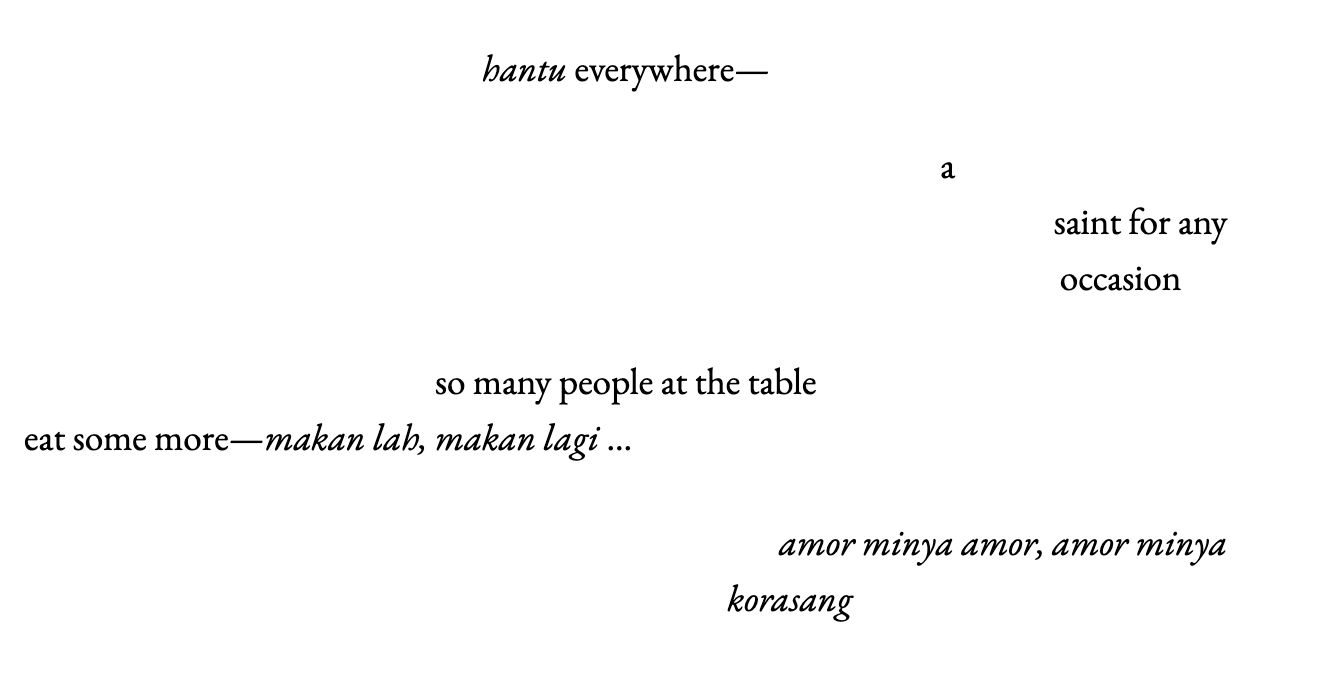
(“queda de pétalas: fragments of a Eurasian childhood”, Petals Fall, 2022)
This disordered visual form (inspired by the peneira poroso poetic form developed in Kristang communities) becomes a poetic device, allowing the reader to feel the spontaneity and disorientation of the remembered experience of childhood in Malaysia.
Conclusion
Anita Patel’s poetics and imagery consistently unfold with grounded metaphors. Cuisines and recipes often become part of a deeper narrative strategy. Her poems are not merely autobiographical reflections. They are interventions—linguistic and cultural reclamations that speak to broader questions of identity and displacement. The poems capture the search for home, adapting to a new country, and innate resistance (quietly and gently unrelenting) to certain age-old passed on perspectives. Her work reminds us of the power of poetry to hold memory, and challenge silence. Patel’s poem “Unfastened” contemplates the essential link between life and art. Metaphors like “needles and hook turning thread to cloth” and “unfastened from the mystery of our own hands” speak to the power of how lived experiences can be transformed in memory. The invitation to “leave the poem behind” carries a meditative quality, reminding us that poetry, like all art, is not only about creation but about being fully present.
Works cited
Patel, Anita. A Common Garment. Australia: Recent Work Press, 2019.
—. Petals Fall. Australia: Recent Work Press, 2022.
