Justin Chin (1969–2015)
BIOGRAPHY
Justin Chin was born in Kuantan, Pahang, in Malaysia to Christian parents in 1969. He was sent to Singapore as a child by his parents and attended the Anglo-Chinese School and Anglo-Chinese Junior College. He consequently enrolled at Hawaiʻi Pacific College’s journalism programme, before transferring to the University of Hawaiʻi at Manoa. It was there that Chin took an introductory creative writing course. Taught by poet and visual artist Faye Kicknosway, she would become influential in Chin’s early career and introduce him to Asian American writers such as Lisa Asagi and R. Zamora Linmark. In 1990, Chin attended the inaugural Outwrite Conference in San Francisco. A landmark annual conference, it offered lectures and workshops for LGBTQ+ writers and would prove hugely influential to Chin (Zinman, ‘Justin Chin’, Making Queer History).
This would prompt Chin to relocate to San Francisco as he enrolled in San Francisco State University’s journalism programme. Chin graduated in 1991 having gained an interest in performance art, essays, and poetry. Marc Zinman writes that in the 1990s, the city was “shaped by overlapping forces: the aftershocks of the AIDS crisis, the vibrancy of queer performance culture, and a spoken-word movement that emphasized immediacy and embodiment. Within this environment, Chin was able to both find and form a literary community that valued the combination of political urgency and aesthetic experimentation” (Zinman, ‘Justin Chin’, Making Queer History). With an interest in spoken word poetry, he became a member of the 1995 and 1996 San Francisco National Poetry Slam teams (‘Justin Chin’, poets.org).
In San Francisco, Chin established himself as a poet, essayist, and performer. Among other themes, his work “combined humor, confrontation, and narrative vulnerability and allowed him to address racism, homophobia, fetishization, and diasporic alienation with both theatrical timing and lyrical precision” (Zinman, ‘Justin Chin’, Making Queer History). Chin stated in an interview with Frigate magazine that, “Every work of art that works as art is a critique” (‘Justin Chin’, poets.org).
In 1997, Chin’s first poetry collection, Bite Hard (Manic D Press), was published. This was followed by Harmless Medicine (Manic D Press, 2001) and Gutted (Manic D Press, 2006), which received the 2007 Thom Gunn Award and was a finalist for the Lambda Literary Award. Chin’s work is known for its “unflinching, and frequently biting, commentary on racial stereotypes, racial tension, Asian American identity, American consumerism, sexuality, and queer identity” (‘Justin Chin’, poets.org).
Chin was also a prolific writer of prose. He authored four books of prose, including the short story collection 98 Wounds (Manic D Press, 2011), and the quasi-memoir Burden of Ashes (Alyson Books, 2002). On his book Mongrel: Essays, Diatribes + Pranks (St. Martin’s Griffin, 2011), writer Felice Picano stated that “Justin Chin is so terrific in live performances that I was afraid his prose couldn’t live up to my expectations. I was wrong” (‘Justin Chin’, poets.org). Chin’s performance art texts from his performance work between 1993 and 2001 were collated in Attack of the Man-Eating Lotus Blossoms (Suspect Thoughts Press, 2005). These reflect the mix of shorter and full-length performance works over the course of his career.
Chin was also actively involved in the San Francisco literary community as a teacher of workshops, participant in readings, and mentor to emerging writers. Writers who worked with him “frequently recalled his incisive commentary and his commitment to fostering difficult but necessary conversations about race and sexuality within queer spaces” (Zinman, ‘Justin Chin’, Making Queer History).
Chin received fellowships and grants including from the California Arts Council, the Djerassi Artist Residency, the Franklin Furnace Fund for Performance Art Awards, the PEN American Center, and the PEN Center USA West.
Chin passed away in San Francisco on December 24, 2015, after a massive stroke. Posthumous collections such as Justin Chin: Selected Works (Manic D Press, Inc., 2016) offer a curated selection of Chin’s writing for new audiences. They highlight themes that continue to resonate with readers today, including “racialized desire, queer belonging, illness, grief, and the instability of identity categories” (Zinman, ‘Justin Chin’, Making Queer History).
References
“Justin Chin”. poets.org.
Zinman, Marc. “Justin Chin.” Making Queer History. 2 April 2026.
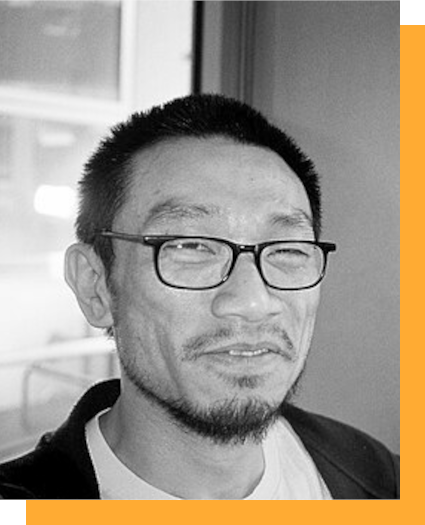
Author Photo © Kevin Killian. Author Biography © Jonathan Chan. All rights reserved.
