
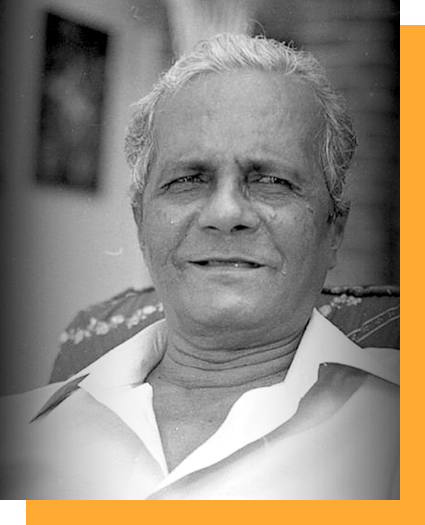
Singai Mukilan (1922-1992)
1. BIOGRAPHY
2. CRITICAL INTRODUCTION
3. SELECTED PUBLICATIONS
4. SELECTED POEMS
இதுவா வாழ்க்கை? [Is this what life is?]
சிரிக்காதா வையம்? [Won’t the world laugh at you?]
அவன்! [He!]
தமிழர் நிலை! [The status of Tamils]
BIOGRAPHY
N. Abdul Rahman or Singai Mukilan as he is known in the literary world, was one of Singapore’s pioneering and well-known Tamil poets. Over his lifetime, he published nine volumes of poetry, along with books of parables and short stories. He continued to write for Singapore’s Tamil daily, Tamil Murasu, until his death in 1992. His chosen pen name, Singai Mukilan — literally meaning “Cloud of Singapore” (Singai being a Tamil abbreviation for Singapore, and Mukilan referring to a rain-bearing cloud in Tamil poetic tradition) — symbolised both his rootedness in the local landscape and his aspiration to refresh and nurture Tamil poetic tradition in Singapore, much like life-giving rain.
Born in 1922 in Cholapuram, in the southern Indian state of Tamil Nadu, Singai Mukilan migrated to Malaya at the age of 16 and began working in a provision store in Malacca. His first poem was published at the age of 17 in Kudi Arasu, a weekly Tamil magazine run by E.V. Ramasamy, popularly known as Periyar, an iconoclastic Indian social reformer. Periyar’s radical reformist ideas - his anti-caste concerns, rationalism, and Self-Respect Movement that targeted caste hierarchies and discirmination—originated in southern India and found resonance among Singapore’s Tamil diaspora which was negotiating with questions of identity, language, and caste in a multiracial colonial port-city. Plantation labourers who constituted the majority of Tamil diaspora in Malaya faced discrimination along multiple axis of race, class and colonialism. Periyar’s Self-Respect Movement¹ sought to affirm dignity and self-worth during their work in the estates as a counter to colonial exploitation, dehumanization, and the racialized stigma of “coolie” status. In the 1920s–30s, newspapers, pamphlets, and Tamil associations circulated Periyar’s thoughts, shaping the Tamil press (notably Tamil Murasu, founded in 1935) as well as cultural organizations such as reading societies and literary circles during the decades.
By the age of 18, in 1939, Mukilan had already published two volumes of poetry—Tamil Oli Geetham 1 and 2—in association with the Tamil Reform Association (TRA). Established in the 1930s and influenced by Periyar’s ideology, TRA adapted social and cultural reform of Periyar’s Self-Respect movement to the concerns of Singapore’s Tamil community spurring demands of Tamil representation, eradication of caste hierarchies, promoting education, abolition of toddy shops and preventing the use of derogatory term ‘kling.’ Hence, while drawing inspiration from Periyar’s Self-Respect movement, TRA was grounded in the Tamil community in Malaya, in Singapore in particular.
Echoing Periyar’s ideology, Mukilan’s early works reflect his deep engagement with the social condition of Tamil society and a pressing call for reform. The themes of Mukilan’s poetry include the concerns over the caste divisions among the Tamil diaspora, misogyny and the condition of women, and so on. During the same time, in addition to writing and publishing for the TRA, Mukilan was also closely involved with the Malayan Dravidian Association, an organisation committed to the cultural, literary, and intellectual revival of the Tamils in Malaya. This cultural revival of the 1930s–40s sought to address the central issues confronting the Tamil community in Singapore and Malaya under British colonial rule. Large-scale displacement of Tamils, many from working-class and plantation backgrounds, had produced anxieties over cultural erasure in a multiracial and hierarchical colonial environment. Singapore, as the administrative and commercial hub of the Straits Settlements, became a focal point for Tamil thought and politics, with its newspapers such as Tamil Murasu circulating widely across plantations and towns. Cultural associations, literary societies, drama troupes, and reading rooms cultivated linguistic and intellectual links, sustaining Tamil language and literature while also creating spaces for poetry, fiction, and political commentary. These networks nurtured a cultural movement in which language revival, theatre, and oratorical competitions worked alongside reformist impulses that advocated equality and dignity in a society fragmented by caste hierarchies transplanted from India as well as the conditions of marginalization and cultural erasure in Malaya. For plantation workers, popular drama, literature, and associational life cultivated a sense of solidarity; through these, they engaged with thoughts behind Periyar’s Self-Respect Movement and Indian nationalism, situating their local concerns within wider reformist currents. Links to India remained strong: Tamil revivalism and Periyarist rationalism resonated in the diaspora, while leaders such as Gandhi and Subhas Chandra Bose inspired political mobilization, culminating in the Indian National Army’s activities in Singapore during the 1940s. During the Japanese Occupation, several Tamil publications supported the Indian anti-colonial movement, calling for the withdrawal of British forces from India. The rise of the Indian National Army (INA) galvanised Indian nationalist sentiment in Malaya. Serving as a signaller in the INA, Mukilan composed a set of Indian National Army Songs, which were later published in 1964. He worked as a proof reader for Tamil Murasu. The reformist themes of Mukilan’s poetry, his concerns over Tamil diasporic society and its social ills, along with the preoccupation with transnational anticolonial politics, in India and Singapore shows the way the diasporic Tamils participated in the intellectual and cultural flows. Print, performance, and politics connected the local struggles for dignity and identity with the broader Asian movements.
His first poetry collection in Singapore, Thudikkum Ullam (The Beating Heart), was published in 1954. While Mukilan also wrote short stories and parables, his greatest strength lay in poetry. His poetic style blends the features of classical Tamil poetry with contemporary issues, conveyed in simple, direct language that resonated with everyday readers.
In 1988, he became the first Singaporean Tamil poet to be awarded the Cultural Medallion, Singapore’s highest honour in the arts. His legacy is further preserved through the Tamil Digital Heritage Project—a collaboration led by the Tamil Digital Heritage Group, an NGO, and the National Library Board of Singapore to digitise and archive Tamil literature from 1965 to 2015. Singai Mukilan’s works are included among those selected for this initiative.
Notes
¹ Periyar’s Self Respect Movement aimed to challenge the oppression and discrimination caused by the caste system, and promoted social equality, gender rights, and rationalism. It significantly influenced the social, political, and cultural landscapes of Tamil Nadu and Southern India.
Author Photo © Arts House Group. Author Biography © Dr Vandana Saxena and Dr. Nithiya Guna Saigaran. All rights reserved.
