
Singai Mukilan (1922-1992)
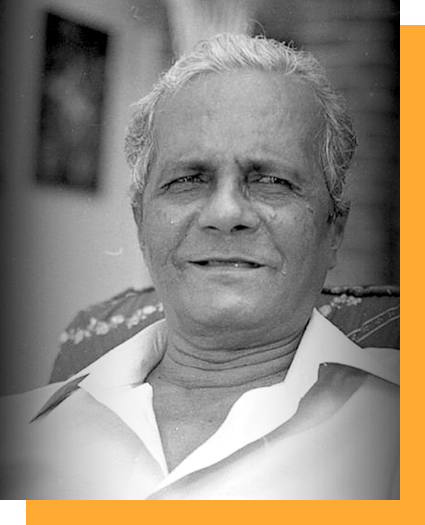
1. BIOGRAPHY
2. CRITICAL INTRODUCTION
3. SELECTED PUBLICATIONS
4. SELECTED POEMS
இதுவா வாழ்க்கை? [Is this what life is?]
சிரிக்காதா வையம்? [Won’t the world laugh at you?]
அவன்! [He!]
தமிழர் நிலை! [The status of Tamils]
CRITICAL INTRODUCTION
Written by Dr Vandana Saxena and Dr. Nithiya Guna Saigaran
With translations by Mutharasu Ramasamy
Dated 11 Sep 2026
Mukilan’s poetry presents an early and consistent voice in Singapore’s literary and language traditions. His use of Tamil to articulate the lived realities of Malaya—questions of belonging, identity, and dignity—firmly grounds Tamil literature within the social and cultural fabric of the peninsula. His inclusion in Singapore poetry is justified not only by his prolific literary output but also by the trajectory of his life and work that connects Malaysia and Singapore. Having spent his formative years in Malaya before moving to Singapore, he remained deeply connected to both contexts: he wrote for Singapore newspapers, maintained close ties with reformist circles like the Tamil Reform Association, and shared concerns of Tamils across Malaya and Singapore. Even after the political separation of Malaysia and Singapore, the social issues that animated his poetry—caste, labour exploitation, women’s issues, dignity, and cultural survival—remained the same across borders, reflecting the entwined histories of the Tamil diaspora in both the nations. Stylistically, while he drew from the rich heritage of Tamil poetic forms, he modified and simplified it, making his verse direct, accessible, and hard-hitting, so that it resonated with everyday working-class readers. Mukilan thus evolved a distinctive, transnational tradition of Tamil poetry that transcended political boundaries. His corpus demonstrates how the cultural and intellectual life of Singapore’s Tamils cannot be disentangled from that of Malaya; his works is situated at the heart of a cross-border literary tradition that is both Singaporean and diasporic.
Mukilan’s poems are charged with the urgency of a minority community negotiating its space within a multilingual, multiracial nation. At the heart of his poetics lies the metaphor of the heart—a “beating heart,” or a “Tamil heart”—which emerges as a recurring symbol of Tamil cultural survival, communal solidarity, and the conscience of its people. The question of belonging is central to Mukilan’s poetry. In one of his poems titled “What use is thinking?”, he says:
We Tamils say, we have been in this country
for many generations,
we have given our voice and laboured
to make this country prosperous.
Yet this pride is swiftly undercut by the poet’s question:
But today, how many institutions are there
that can revive the dying education system,
or a permanent forum to nurture the raw nerve?(Mukilan 2-3)
Here, Mukilan identifies a paradox—the Tamil contribution to the nation’s prosperity co-exists alongside neglect and the erosion of its cultural institutions. The poem’s style is markedly simple, with its rhetorical questions fusing politics and social inquiry. The final line of the poem (“We, dear Tamils, must think”) intends to shake them out of complacency that has crept in with the prevalent systems and institutions of discrimination like caste and patriarchy. Caste emerges as another central theme. The influence of the reform movements is evident in the anti-caste critique in Mukilan’s poetry, when he insists that,
“An association will rise against caste.”
The desire for a casteless and egalitarian community is haunted by the fear of rejection from the existing community that has grown complacent with their present lot—so strongly are the existing social systems entrenched in the psyche of Tamil migrants to Malaya. In another poem “Tamil Nilai" [The Tamil Situation], he describes the uphill nature of the reformist tasks. His call for unity mobilises many but the organisation formed in response remains divided.
I asked, ‘Why are you coming this way?’
We are forming an association in the name of the people of
Our ancestral village, and I am going to see Thogaiappar
At his noble place where he stays“If we are to form an association
For only ten of us, then what is the status
Of our fine Tamil community?”
When Muthappan retorted,
He said, “Your dying words do not have any soul in them”
He walked away angrily and I stood there
shocked and unable to move”Having listened to what Muthappan said
I dug a hole to bury my moving thoughts
And said, “Let the bagasse heart collapse and fall”
Only if such collapses happen
Our status as Tamils will rise for the better,” he said and left.(Mukilan 55-56)
The dialogic style stages the debate over the collective identity of Tamil community. The speaker, who is initially open to the formation of an association, becomes aware of the fragmentation and exclusion underlying the very conception of Tamil organisations that are based on caste or ancestral village. What appears to be community-building in fact divides the community into smaller, inward-looking groups rather than creating a larger solidarity. Such hollow gestures of community formation should collapse (“like the bagasse heart”) before genuine renewal can occur. Mukilan’s poetry repeatedly captures the tension between persistence of parochial identities and the requirements of a larger communal solidarity—a recurring paradox of Singapore’s Tamil community.
Along with themes of Tamil identity and communal solidarity, Mukilan’s poetry also exposes the fractures within the home. Domestic violence, the poor treatment of women, and alcoholism—the overall deterioration of social fabric is a persistent concern across these three phenomena. Periyar’s reformist ideology particularly focused on the state of Tamil women. In Malaya, and later in Singapore, Tamil women faced challenges like lack of education, economic dependence, abuse and unequal pay along with the prevailing expectations of domesticity in a traditionally patriarchal set up. Mukilan often adopts a woman’s voice to expose the hidden realities of the domestic sphere, making private suffering a public, political and societal issue. His poem “Is this life” depicts a woman’s life that is marked by excessive, incessant labour but more brutally, the menacing presence of the man:
He will be hiding to watch me, rearing his head
Like a snake poised to strike!
The promises of love are followed by scenes of violence and humiliation.
At the factory, he works tirelessly all day,
Spending his wages earned on that day on toddy
In the evening, he returns home in a drunken haze,
and beats me as he pleases.
Those walking on the street, passing my house,
Would rush to save me from my plight
Is this what life is?(Mukilan 10-11)
Each episode of humiliation, beating, or shaming feeds into this larger existential question: “Is this what life is?” The repetition captures the sense of entrapment and monotony of a woman’s life. In terms of the poetic form, the practice of men voicing women’s experience has deep literary antecedents across South Asian poetic traditions, including Tamil Bhakti poetry where male poets often used female voice to articulate emotions of pain and longing and dramatize their intensity. Mukilan’s use of the woman’s voice gives it a new political resonance in the diasporic context. It fills in the gap left by the absence of Tamil women poets and writers in Malaya, who often lacked access to education, literary networks, and publishing opportunities. In this sense, Mukilan’s appropriation of the woman’s voice is both conventional and compensatory. This strand of Mukilan’s poetry insists that the community’s struggle for survival and dignity in Malaya must confront its own flaws. His love poetry, rather than elevating the abstract sentiment, describes the relational dynamics of power that underlie the man-woman relationship in a patriarchal setting. The poems where he takes on the woman’s voice show how the lives of women are a measure of Tamil dignity.
Mukilan’s poetry is the record of the Tamil community’s social and political life in Malaya. His poems express his dissatisfaction with the parochial attitudes, the systems of patriarchy and caste which the Tamil community brought from India. He repeatedly articulates the desire for solidarity. The verses oscillate between defiance and weariness. In Mukilan’s poetry Tamil identity and community emerge as a living force oriented toward the possibilities of the future.
Works cited
Culture Organisations: Centre for Singapore Tamil Culture, and National Library Board Singapore. ‘Abdul Rahman, N (Singai Mukilan),’ Encyclopedia of Singapore Tamils Centre for Singapore Tamil Culture, www.nlb.gov.sg/main/article-detail?cmsuuid=d7075260-615b-4fea-9a0b-a33c3da7f447. Accessed 24 Aug. 2025.
Singai Mukilan. Thudikkum Ullam. Singapore: 1954
